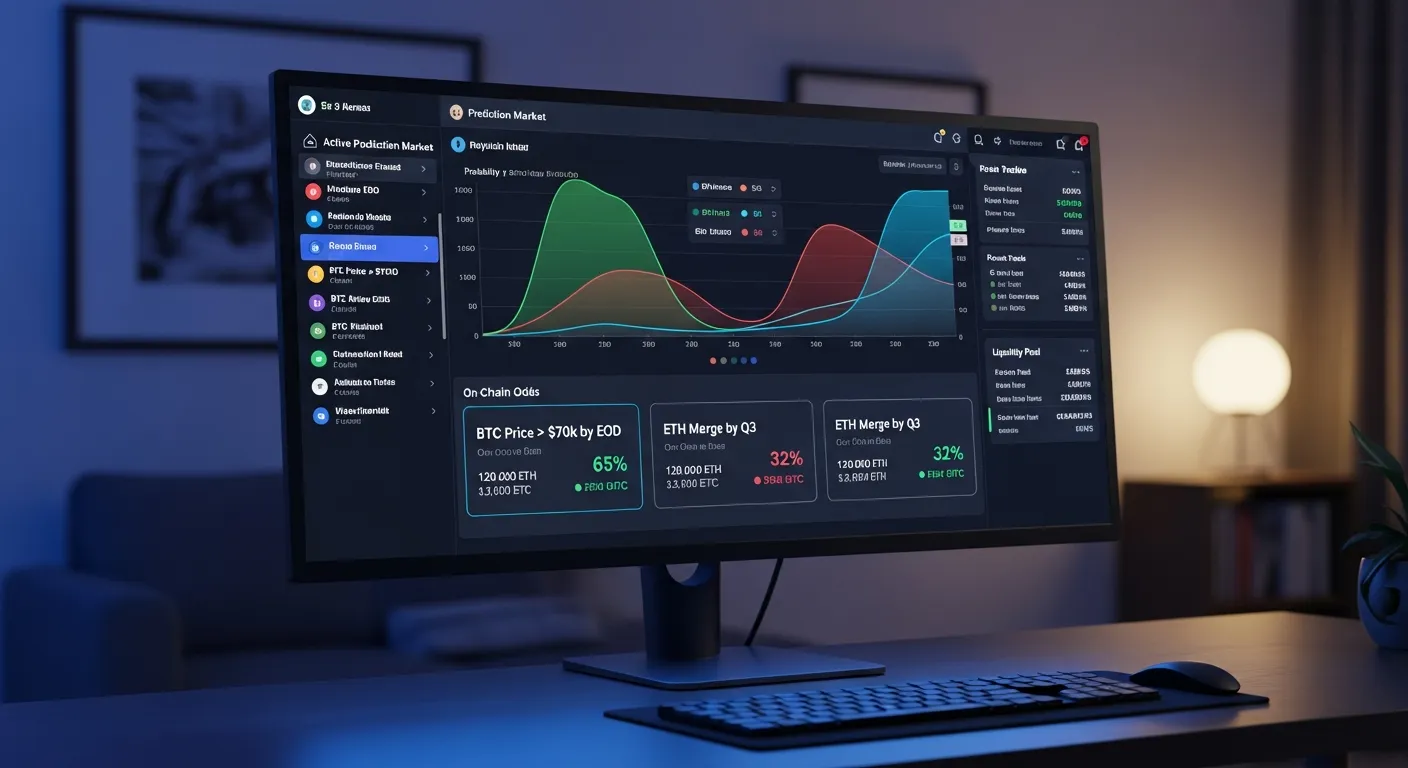
#Prediction Markets 101: The Crypto-Native Evolution of Sports Betting & Financial Trading
In the weeks leading up to a closely watched central bank decision last year, some of the fastest-moving signals were not coming from futures curves, economist surveys, or leaked briefings. They were emerging from offshore prediction markets, where traders and bettors were staking capital on binary outcomes tied to policy decisions, with prices adjusting in real time as rumours and probabilities shifted.
The volumes were small by institutional standards. The signal was not. Prices moved earlier than in listed derivatives, and often with greater conviction. For market participants watching from the sidelines, the implication was uncomfortable. A corner of the internet long treated as speculative theatre was, at least temporarily, acting as a more responsive barometer of belief than regulated markets designed for exactly that purpose.
This is the context in which prediction markets have re-entered serious financial conversation. Not as novelties or academic experiments, but as functioning venues where capital expresses conviction ahead of consensus. Their growth has coincided with a period of regulatory strain, fragmented enforcement, and a steady migration of risk-taking behaviour onto crypto rails.
Prediction markets now sit awkwardly between betting slips and trading terminals. They borrow the language of finance, the mechanics of gambling, and the infrastructure of decentralised networks. Neither regulators nor incumbents fully own them. That unresolved tension, more than any technological breakthrough, explains why they matter now.
#A regulatory gap that widened faster than oversight
The renewed relevance of prediction markets owes less to ideological enthusiasm for decentralisation than to regulatory asymmetry. Sports betting remains tightly constrained by national licensing regimes. Even global operators function as collections of jurisdiction-specific platforms, each shaped by local law, taxation, and enforcement priorities. Financial markets, meanwhile, have moved in the opposite direction, with post-crisis reforms expanding oversight of derivatives, exchanges, and intermediaries.
Prediction markets fall between these frameworks. Contracts tied to elections, macroeconomic outcomes, or public data releases are often presented as informational instruments rather than wagers. That distinction has proven durable enough to delay comprehensive regulation, even if it rarely survives sustained scrutiny. This ambiguity is explored in greater depth in Prediction Markets as Betting Hubs: Beyond Sports, Beyond the Fringe, which traces how these platforms evolved outside traditional sportsbook controls while attracting increasingly serious capital.
Crypto infrastructure widened the gap. Smart contracts removed the need for licensed custodians. Stablecoins reduced reliance on banking access. Wallet-based participation bypassed traditional customer onboarding altogether. For users in restricted jurisdictions, the appeal was immediate. For regulators, the enforcement challenge became structural rather than procedural.
In the United States, regulators have signalled discomfort without resolving classification. The Commodity Futures Trading Commission has questioned whether event-based contracts constitute unregulated derivatives, particularly when tied to political outcomes. Enforcement has been selective and episodic, targeting visibility rather than volume. In Europe, gambling authorities and financial regulators have taken divergent approaches, sometimes within the same jurisdiction.
This uncertainty created space. Platforms such as Polymarket expanded most aggressively during periods of heightened political and macroeconomic stress, when demand for directional exposure spiked and traditional venues moved more slowly. Market participants argue that the demand exists regardless of legal clarity. Regulators counter that demand does not confer legitimacy. Neither side has forced a decisive resolution.
#Why mechanics matter more than marketing
Understanding how crypto-native prediction markets function is essential to understanding why they have proved so resilient. At a structural level, the contracts are straightforward. A market pays out a fixed amount if a defined event occurs and nothing if it does not. Prices fluctuate between zero and one, reflecting implied probability.
What crypto changes is the environment around those contracts. Liquidity pools often replace order books, allowing markets to operate with fewer active participants. Automated market makers adjust prices based on flow rather than negotiation. Settlement is deterministic and near-instant, enforced by code rather than clearing houses. These mechanics mirror broader trends across decentralised wagering, outlined in On-Chain Betting Explained: What It Means for Players in 2025, where smart contracts increasingly replace bookmaker discretion.
Collateral is posted upfront. There is no margin in the conventional sense, but capital is at risk from the moment a position is opened. For derivatives traders, this feels conservative. For gamblers, it feels unusually transparent.
At the centre of the system sit oracles, which determine whether an event has occurred and trigger payouts. In sports markets, outcomes are usually unambiguous. In political or economic markets, they are not. Disputes over data sources, timing, or interpretation can freeze capital and undermine confidence. Market operators argue these risks are manageable. Critics contend they are structurally underpriced, particularly as volumes grow.
Unlike sportsbooks, prediction markets do not set odds with embedded margins. Prices emerge from flow. That attracts participants who believe the crowd is wrong, not those seeking entertainment. It also introduces fragility. Thin liquidity can exaggerate price swings around news events, creating volatility that looks less like price discovery and more like reflex.
The result is a market that behaves less like a casino and more like a sentiment engine, albeit one with uneven depth and limited safeguards.
#The quiet pressure this puts on sportsbooks
For traditional sports betting operators, prediction markets present an uncomfortable comparison. On the surface, both offer exposure to match outcomes, tournaments, and season-long performance. Beneath that, the economics diverge sharply.
Sportsbooks manage risk by balancing books and adjusting odds to protect margin. Prediction markets externalise risk entirely. The platform earns fees on volume, not outcome. There is no house position to hedge, and no exposure to a run of unlikely results.
That distinction matters in volatile markets. When unexpected outcomes hit sportsbooks, losses can be severe. In prediction markets, losses are distributed across participants who mispriced the event. The platform’s revenue is largely insulated from the result.
Industry insiders have noticed, particularly as in-play betting volumes rise and pricing windows shrink. Prediction markets are structurally better suited to absorb sudden information shocks, even if they struggle with depth.
There is also a behavioural shift underway. Younger bettors with exposure to crypto trading are comfortable with peer-to-peer markets and probabilistic pricing. They are less attached to the narrative of “the house versus the player.” For them, trading and betting already blur. This shift is closely linked to changing incentive models explored in Tokenized Loyalty Is Killing VIP Points in Crypto Gambling, where users increasingly prioritise liquidity and yield over traditional perks.
Sports leagues and regulators remain cautious. Integrity concerns persist, and prediction markets do not always enforce the same monitoring standards as licensed sportsbooks. Yet their transparency, with positions visible on-chain, offers a different audit trail. Whether that satisfies regulators remains unresolved.
#Information markets, belief markets, and the gap between them
Advocates of prediction markets often cite their ability to aggregate information more efficiently than polls or expert forecasts. Academic literature supports the claim under specific conditions. In practice, those conditions are unevenly met.
Liquidity is the first constraint. Thin markets are easily distorted by large positions or coordinated flow. Narrative is the second. In politically charged markets, prices often reflect belief and identity as much as information. Sports markets are less exposed to this dynamic, but not immune to it.
There is also reflexivity to consider. Once prediction markets are treated as indicators, participants begin trading not on outcomes, but on how others will react to price movements. At that point, the market measures itself rather than the underlying event.
Institutional participants are aware of these limits. Some hedge funds monitor prediction markets as supplementary data, particularly during fast-moving news cycles. Few treat them as primary trading venues. Others trade opportunistically during dislocations, when regulatory uncertainty or platform constraints deter casual participants.
The idea that prediction markets offer a pure read on truth is overstated. They offer a read on belief, priced in capital, shaped by incentives and constraints like any other market.
#Who participates, and why scale remains elusive
Despite headline volumes during high-profile events, the user base of crypto-native prediction markets remains relatively narrow. It skews toward crypto-literate traders, professional gamblers, and politically engaged participants. Geography reflects regulation more than demand, with higher participation from jurisdictions where access to traditional betting or derivatives is restricted.
Retail users tend to arrive during peak moments and leave once volatility subsides. Liquidity providers and repeat traders sustain markets between events. Platform incentives, including token rewards or fee rebates, influence participation patterns and, at times, price behaviour.
There is little evidence of mass adoption beyond these niches. Venture investors nevertheless continue to allocate capital, drawn by the optionality inherent in platforms that can pivot between information markets, hedging tools, and entertainment products depending on regulatory outcomes. This speculative capital cycle mirrors broader trends outlined in The 2026 Crypto Wager: Dissecting the High-Stakes Future of Gambling Tokens, where valuation often runs ahead of regulatory clarity.
#The classification question no one wants to settle
The central tension facing prediction markets is classification. If treated as gambling, they face licensing regimes that undermine permissionless access. If treated as financial instruments, they encounter disclosure, reporting, and suitability requirements few platforms are equipped to meet.
Some industry participants argue for bespoke frameworks. Regulators remain sceptical, wary of creating carve-outs that invite arbitrage. Enforcement to date suggests a strategy of containment rather than accommodation.
In the near term, selective scrutiny is likely. Political markets attract attention because of visibility and perceived social impact. Sports markets may draw less focus, particularly when framed as informational or hedging tools rather than bets.
Over a longer horizon, integration with traditional finance is possible but uncertain. Exchanges could list event-based contracts under existing derivatives rules, stripping away much of what makes crypto-native platforms distinctive. Alternatively, prediction markets could retreat further offshore, entrenching their role as parallel systems rather than competitors.
#What this signals for iGaming over the next cycle
For the iGaming sector, prediction markets function as both warning and signal. They reveal demand for products that treat odds as probabilities and bettors as price-takers, not customers. They also expose the limits of regulatory fragmentation in a world of mobile capital.
Established operators are experimenting quietly. Some are exploring exchange-style models. Others are investing in data and analytics to capture informational flow without touching the underlying markets. Few are willing to confront regulators directly.
Crypto-native platforms face a different risk. As volumes grow, so does scrutiny. The features that enable rapid scaling also make these markets difficult to defend in policy debates. Market participants understand this, even if marketing materials do not.
Prediction markets will not replace sportsbooks or futures exchanges. They do not need to. Their influence lies in what they reveal about how capital behaves when constraints are loosened. That insight, uncomfortable as it may be for regulators and incumbents, explains why these markets keep resurfacing.
The question is not whether prediction markets function. It is whether the systems built around them can survive the attention they increasingly attract.