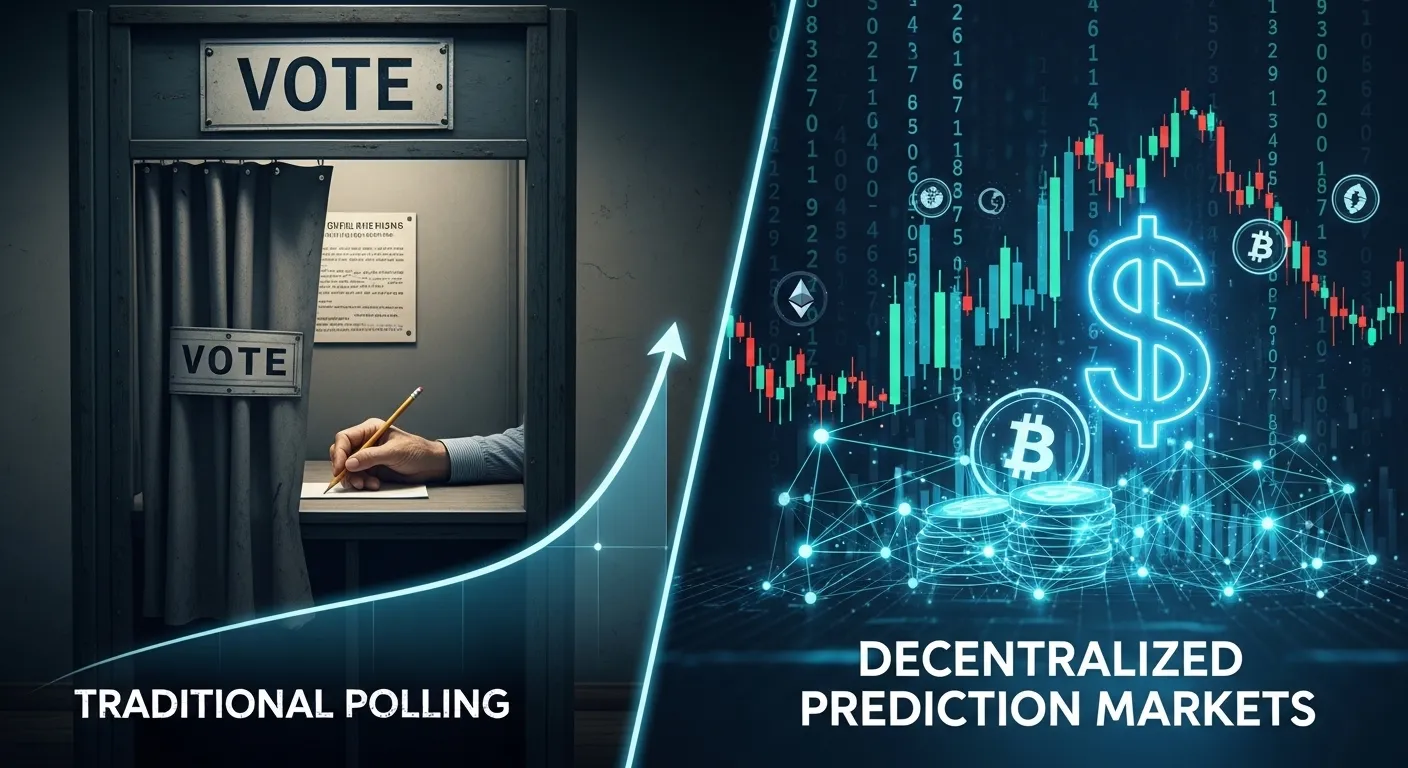
#Polls vs. Prices: Why Crypto Prediction Markets Often Outperform Traditional Data
The post-mortem of the 2024-2025 global election cycle has largely ignored the pollsters and focused instead on the ledger. While legacy media spent millions on demographic weighting and telephone surveys that were increasingly ignored by a digital-first electorate, the decentralized prediction markets—led by platforms like Polymarket, Drift, and Wintermute’s nascent venues—provided a real-time, high-fidelity alternative. What was once dismissed as a niche "crypto-native" hobby has matured into a foundational piece of the global information architecture.
The tension is no longer theoretical. In the final weeks of 2025, as central banks navigated a volatile inflationary "second wave" and political transitions in the West triggered massive capital reallocations, the divergence between public sentiment data and market-priced probability reached a breaking point. On-chain markets didn't just capture a "shy" voter or a hidden sports fan; they captured the reality of capital. This structural shift is part of a broader movement explored in Crypto Betting in 2026: How Faster Settlement and Stablecoins Are Rewriting the Odds, where efficiency is replacing traditional gatekeeping.
For professional traders and industry insiders, this shift represents a move from retrospective analysis to predictive intelligence. As liquidity in these markets now routinely clears the $5 billion mark, the fundamental question for ValueTheMarkets.com readers is not whether these markets are "gambling," but why they are increasingly the most reliable source of truth in an era of deepfakes and data decay.
#The Incentive of Truth: Breaking the Social Desirability Bias
The fundamental failure of traditional polling lies in its lack of a "punishment" for inaccuracy. In a hyper-polarized social climate, "social desirability bias" creates a corrupting feedback loop. Participants provide answers that signal a specific identity or satisfy a perceived social norm. There is zero cost to being wrong in a poll, and zero reward for being honest.
Prediction markets operate on a Darwinian psychological plane. Every participant acts as a forecaster with a financial incentive to be objective. If a trader allows personal bias to dictate their position, they effectively subsidize the more rational participants. This creates a "price discovery of probability" that acts as a ruthless filter for noise.
Market participants describe this as the end of the "expert" monopoly. In the sports world, the "closing line" has long been the gold standard for predicted outcomes. Crypto prediction markets have simply scaled this logic to cover everything from the approval of a Spot Ethereum ETF to the likelihood of a specific trade tariff. The move from "opinion" to "priced risk" is the primary catalyst for the sector’s 2026 expansion, a trend further analyzed in Prediction Markets Beyond Sports | Crypto Gambling & iGaming 2026.
#Internal Hub: The Technical Foundation of Betting
How Blockchain Is Transforming Online Gambling: Faster Payouts & Provable Fairness
Avalanche (AVAX) for Betting: The Ultimate Investment Thesis
#On-Chain Liquidity and the Collapse of the "Whale" Narrative
A persistent criticism of decentralized markets is their susceptibility to "whales"—high-net-worth individuals who theoretically manipulate prices to create a false narrative. However, the 2025 trading data suggests the opposite. In a liquid, decentralized market, a manipulator attempting to push the price away from its true probability is essentially offering a "market-maker's gift" to the rest of the world.
When a whale pushes a contract’s price to an irrational level, it triggers an immediate response from sophisticated arbitrageurs. The "slippage" and "adverse selection" faced by a manipulator in a $100 million pool are massive. Rather than distorting the truth, large, irrational trades provide the necessary incentive for rational capital to enter the market and correct the price. As outlined in Crypto Arbitrage Betting: Advanced Strategies for Maximum Profits, speed and scale are the ultimate correctives to market manipulation.
Institutional-grade liquidity has now entered these protocols, often from hedge funds that view prediction markets as a superior hedging tool compared to traditional derivatives. When millions are at stake, the "wisdom of the crowd" ceases to be a collection of guesses; it becomes the mathematical byproduct of competing interests seeking to maximize return through accuracy.
#Regulatory Friction and the Offshore Advantage
Despite their analytical utility, prediction markets remain caught in a regulatory pincer movement. In the United States, the CFTC and SEC have maintained a hostile posture, viewing these platforms through the lens of unregulated binary options. This friction has created a significant "enforcement gap," driving much of the innovation—and the most accurate data—offshore.
Metric | Traditional Polling | Crypto Prediction Markets |
Latency | Days to Weeks (High) | Real-time (Near-Zero) |
Incentive | Social Approval | Capital Gain/Loss |
Accuracy | Retrospective/Lagging | Forward-looking/High Fidelity |
Cost of Entry | Free (Low Signal) | Capital at Risk (High Signal) |
Regulators have signaled concerns over "market integrity" and the potential for these venues to incentivize negative real-world actions. Yet, industry executives point to a growing irony: by suppressing these forecasting tools, regulators may be leaving the public more vulnerable to the volatility of less accurate, easily manipulated legacy data. This environment has paved the way for the Crypto Gambling Boom: Double or Nothing in 2025, where high-stakes participants prioritize transparency over jurisdictional comfort.
#The Behavioral Risk: When Markets Become Digital Echo Chambers
The "skin in the game" argument is not a panacea. Prediction markets are still susceptible to reflexive loops and demographic silos. If a platform is dominated by a specific cohort—for instance, technocratic, risk-seeking males—the market may over-index on outcomes that fit that group's worldview.
This risk is particularly acute in "low-liquidity" or niche markets where a consensus can form around a shared delusion. However, the safeguard is global arbitrage. As prediction markets integrate with the broader financial ecosystem, the barrier between "crypto-native" sentiment and "global macro" reality dissolves. When an on-chain contract is significantly out of sync with a regulated sportsbook in London or a futures desk in Chicago, capital will flow to bridge that gap.
#Internal Hub: Emerging Market Trends
The Great Altcoin Gambling Shift: How SOL, MATIC, and TON Are Unseating Bitcoin
Play-to-Earn vs. Play-to-Win: The Future of Crypto Gambling in 2025
#The "Dark Side" and the Ethics of Catastrophe
As we look toward the 2026-2028 window, we must address the ethical tensions inherent in "betting on disaster." Critics argue that prediction markets could incentivize harmful behavior, such as "assassination markets" or betting on the success of a corporate cyberattack.
While most protocols have implemented "veto committees" or decentralized governance to filter out such contracts, the structural risk remains. The market is agnostic to morality; it only seeks accuracy. Balancing the societal benefit of having an accurate "catastrophe index" with the potential for perverse incentives will be the primary legal battleground of the next three years.
#Conclusion: The New Infrastructure of Reality
The rise of crypto prediction markets represents a fundamental shift in who "owns" the truth. For a century, the ability to forecast the future was the domain of elite institutions and statistical bureaus. That monopoly is being dismantled by a decentralized network of anonymous traders armed with capital and smart contracts.
We are left with a structural insight: in a world of infinite noise, money is the most reliable filter. As we navigate the complexities of 2026, the "cost of being wrong" in a prediction market is the only thing keeping the global information set grounded in reality. The pundits will keep talking, but the markets have already moved.