#Manifold Markets Review: How It Works, and What Investors Should Know
#Introduction
Manifold Markets is an online platform where participants express expectations about future events through probability-driven contracts rather than traditional investment products. It is part of a broader evolution in collective forecasting markets that aggregate beliefs into continuously updated probabilities.
Prediction markets are increasingly referenced not as gambling venues, but as tools that transform diverse opinions into quantifiable signals. When many participants contribute their expectations about geopolitical outcomes, economic indicators, or corporate events, the aggregated probability often provides insights that traditional surveys or commentary may miss. These markets sit at the intersection of information aggregation, sentiment analysis, and decentralized participation.
For retail investors and market watchers, Manifold Markets represents an environment to observe and interpret collective expectations. It is not designed for casual gaming or entertainment. Instead, the focus is on understanding risk, probabilities, and uncertainty — not short-term gains.
# Quick Facts Table
Item | Details |
Platform type | Prediction market platform |
Markets covered | Politics, economics, technology, culture, crypto, miscellaneous events |
Availability | Online access; jurisdiction-dependent in the US |
Regulation status | No formal financial market regulation publicly disclosed |
Fees | Platform-specific and not fully transparent |
Account requirements | Account creation required; KYC requirements no longer required |
Best for | Forecasting enthusiasts, researchers, probabilistic thinkers |
#What Is Manifold Markets?
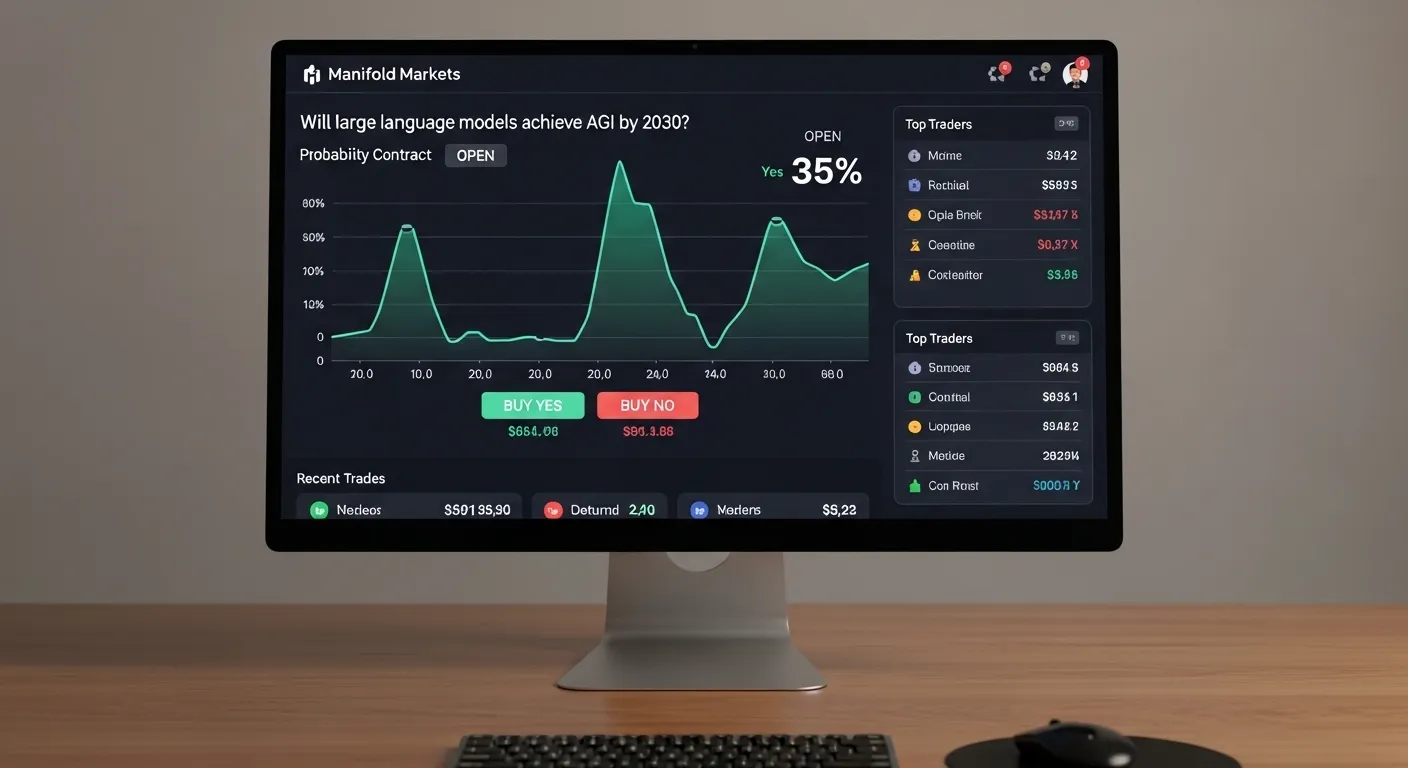
At a plain-English level, Manifold Markets is a site where people trade contracts tied to future events. Each market asks a clearly defined question with discrete outcomes like “Yes” or “No.” Participants express how likely they believe each outcome is, and the platform translates that activity into a probability.
From a technical perspective, the platform uses an automated market maker model rather than an order book. Participants take positions that influence price movement, and these prices reflect implied probabilities — not returns or guarantees. A contract trading at 70 percent suggests the market consensus assigns a 70 percent probability to a given outcome.
Once the underlying event resolves, the market settles according to predefined resolution rules. Clear question framing and robust resolution criteria are critical because ambiguous or disputed outcomes can erode the informational value of the probability signal.
#Is Manifold Markets Legit and Safe?
Manifold Markets operates as an experimental forecasting platform, not a regulated exchange. It does not present itself as a broker or a place to trade regulated financial instruments. Users should not assume protections associated with regulated markets apply to their activity here.
The platform’s approach to identity verification and compliance is not fully transparent and may change over time. Participation rules can vary depending on local laws, and users are responsible for understanding how prediction markets fit within their own regulatory framework.
Prediction markets, including those on Manifold, are not guaranteed to produce accurate forecasts. Probabilities represent collective belief, which can be influenced by group biases, misinformation, or low liquidity. This places the platform in the realm of analytical tools rather than certainty engines.
For additional perspective on how prediction markets are evolving and intersecting with other trading ecosystems, explore our analysis of prediction markets emerging beyond traditional sectors in “ Prediction Markets as Betting Hubs: Beyond Sports, Beyond the Fringe” — a look at the broader structural trends in this space.
#Pros and Cons
Pros
Broad range of market topics spanning policy, technology, crypto, and culture
Emphasis on probabilities and sentiment as information signals
Community-driven market creation supports diversity of ideas
Accessible interface for users new to probabilistic thinking
Cons
Regulatory clarity is limited compared with regulated financial venues
Fee structure is not fully transparent
Quality varies with question design and community moderation
Not intended for users seeking regulated investment protections
#How Manifold Markets Works (Conceptual Overview)
At a conceptual level, a user creates an account and browses available markets. Each market shows a current probability for outcomes based on participant activity.
When participants take positions aligned with their expectations, the probabilities shift. These shifts reflect collective sentiment at a given moment. Positions can change over time as new information becomes available, and probabilities update accordingly.
Once the event resolves — for example, an election result is confirmed or a macroeconomic report is released — the market settles according to its predefined rules. Account balances adjust based on the outcome, completing the cycle. This design reinforces that the platform functions as an information and expectation tool, not a trading venue.
#Market Categories and Typical Use Cases
Manifold Markets has grown to encompass a wide variety of topics:
Economics and macro events: central bank decisions, policy shifts, key economic indicators
Politics and policy: election outcomes, legislative decisions
Corporate or company outcomes: product announcements, funding events
Financial and crypto indicators: price thresholds, regulatory timelines
Culture and global events: awards, scientific milestones
Engagement often focuses on comparing expectations with real-world developments, tracking how probabilities adjust as new data emerges.
If you’re interested in how blockchain and digital markets are transforming adjacent industries, such as gaming and decentralized participation, check out “The Evolution of Cryptocurrency in Gaming: From Novelty to Necessity.”
#Fees, Costs, and Pricing
Prediction markets often embed costs through price movement mechanics rather than explicit line-item fees. Manifold Markets does not publicly offer a simple, standardized fee schedule, and costs may vary by market or participation model.
Trading costs are generally reflected in price dynamics, liquidity, and spreads rather than direct commissions. Manifold Markets primarily operates on a "play money" system using a currency called Mana (Ṁ). Withdrawal costs, if any, are not clearly documented and may depend on platform policy or the funding method chosen by the user. Mana is "play money" and cannot be withdrawn for cash. There is no "withdrawal cost" because there is no withdrawal option, only a "charity donation" option.
Readers should treat fee transparency as an area requiring careful review rather than a settled feature of the platform.
#User Experience and Platform Design
The interface emphasizes clarity and accessibility. Probabilities are immediately visible, and markets are easy to navigate, making the platform approachable for users unfamiliar with prediction markets.
For experienced participants, the ability to create custom markets broadens scope but also introduces variability in quality. The design encourages exploration and discussion rather than advanced analytics and professional-grade forecasting tools.
#Deposits, Withdrawals, and Restrictions
Funding and withdrawal mechanisms vary by jurisdiction and platform policy. Because prediction markets interact with local laws in complex ways, users should confirm eligibility and procedures before committing funds.
Timelines for deposits and withdrawals are not universally defined and may depend on the methods chosen and user verification status. No assurances should be inferred about liquidity or guaranteed access to funds.
For broader context around decentralization and transparency in linked online markets, see “On-Chain Betting in 2025: What It Means for Players.”
#Who Manifold Markets Is Best For — and Who Should Avoid It
Best for
Retail users interested in probabilistic forecasting
Analysts or researchers monitoring sentiment signals
Users comfortable with an experimental, community-driven platform
Should avoid
Individuals seeking regulated financial markets
Those looking for entertainment-oriented or gamified experiences
Users in highly restrictive jurisdictions
Anyone uncomfortable engaging with uncertainty or potential losses
#Manifold Markets vs Alternatives (High-Level Comparison)
Manifold Markets differs from more formal prediction platforms by emphasizing openness and experimentation. Community-created markets expand coverage but place greater responsibility on users to assess quality and credibility.
Its regulatory posture appears lighter than venues with formal oversight. This trade-off favors flexibility and innovation over institutional safeguards. Users should weigh governance, transparency, and intended use when comparing platforms.
For additional insight into how platforms link with broader market trends, explore “Polymarket Partners with Yahoo Finance to Expand Prediction Markets,” which highlights how industry incumbents are integrating prediction data into mainstream financial insights.
#Final Verdict
Manifold Markets has carved out a distinctive space in the broader prediction market landscape. Its strength lies in enabling users to observe and interpret collective expectations rather than offering regulated investment products or assured forecasts.
For analysts and investors interested in probabilistic thinking and evolving sentiment indicators, it provides an informational tool worth exploring. Participation should always be tempered with an understanding of the platform’s limitations, regulatory context, and the inherent uncertainty of collective expectations.
Readers may choose to explore live prediction markets on Manifold Markets, subject to availability and local regulatory conditions.
#Mandatory Disclosures
Affiliate disclosure: This article may contain affiliate links. ValueTheMarkets may earn a commission if readers choose to explore the platform through these links, at no additional cost to the user.
Risk disclaimer: This content is for informational purposes only and does not constitute financial, investment, or trading advice. Prediction markets reflect collective belief, not certainty, and outcomes may be inaccurate.
Geographic and regulatory notice: The legality and availability of prediction markets vary by jurisdiction. Readers are responsible for understanding and complying with applicable local laws before participating.