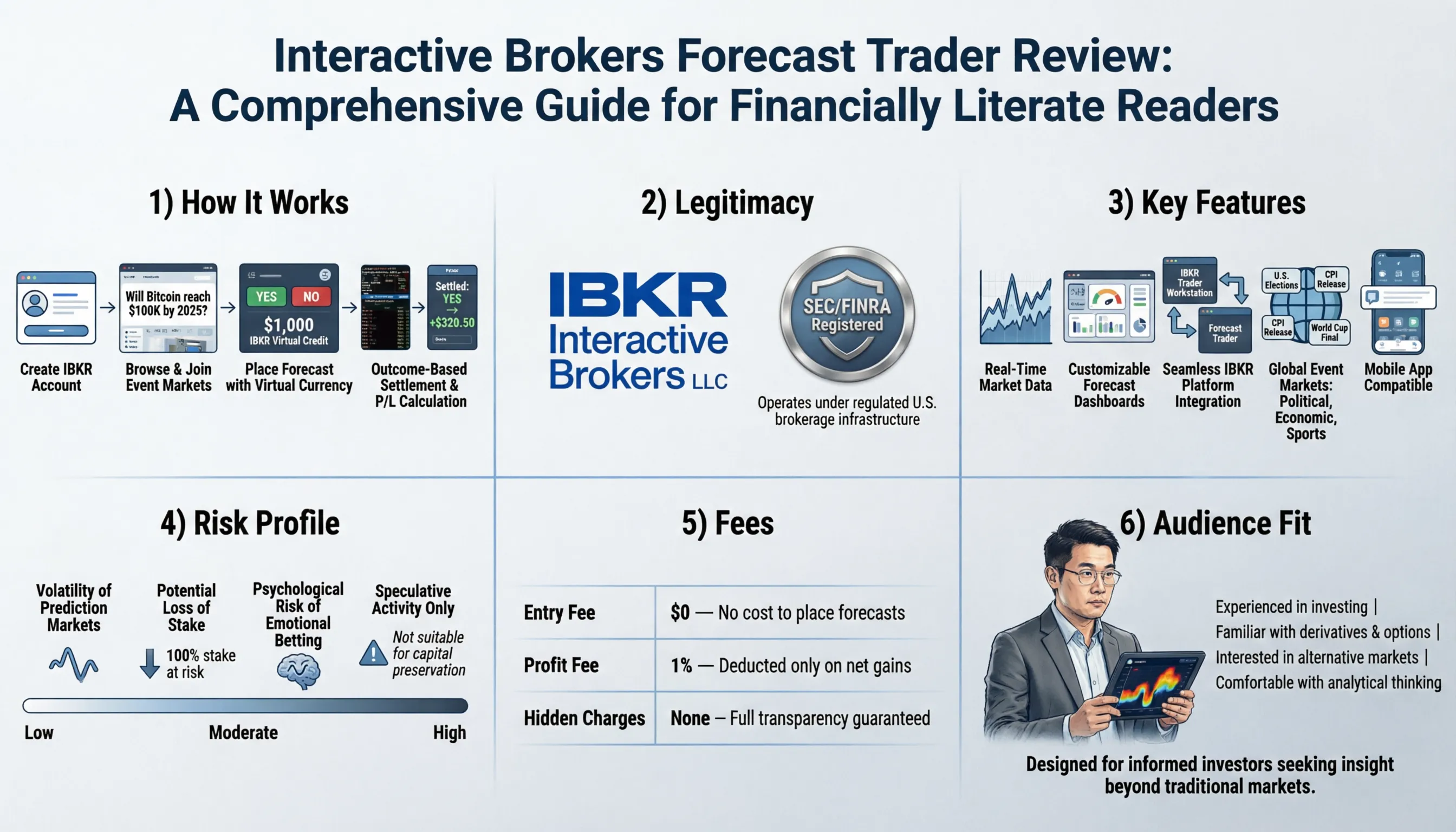
#Interactive Brokers Forecast Trader Review
#Introduction
Interactive Brokers Forecast Trader is a prediction market platform embedded in the Interactive Brokers brokerage ecosystem that lets users trade contracts tied to real-world event outcomes. Instead of focusing on price gains or loss, these markets express expectations about future events as probability-weighted prices.
In an information-driven economy where probabilities move faster than prices, prediction markets serve as collective sentiment indicators that can complement traditional economic data or forecasts. They translate diverse opinions into a single, continuously updated market price.
This review is anchored in investor education. It explains how the platform works, clarifies regulatory and fee standards, and outlines who it is—and isn’t—designed for. It is not meant for casual entertainment or gamblers but for readers who understand risk, uncertainty, and probability-based markets.
#Quick Facts Table
Feature | Detail |
Platform type | Brokerage-linked prediction market |
Operator | Interactive Brokers |
Markets covered | Binary event outcomes |
Market types | Economics, policy, macro, corporate outcomes |
Availability | Jurisdiction dependent |
Regulation | Under IB regulated brokerage umbrella |
Fees | Standard trading commissions (conditional) |
Account requirements | Brokerage onboarding & KYC |
Best for | Practitioners seeking probability signals |
#What Is Interactive Brokers Forecast Trader?
At its core, Interactive Brokers Forecast Trader is a venue where users trade contracts linked to an event’s outcome. Each contract represents a simple Yes/No resolution at a predetermined future date.
More technically, markets are structured as binary contracts. Each contract settles at a fixed value if the stated condition occurs and zero otherwise. Prices between $0 and $1 indicate the crowd’s assessment of the probability of a Yes outcome.
Yes and No contracts are two sides of the same question. Their prices reflect divergent views and collective probability distributions, which settle when the event resolves according to predefined rules. This structure is similar to concepts explored in our piece on Prediction Markets as Betting Hubs: Beyond Sports, Beyond the Fringe, where the binary nature of outcome pricing is discussed in depth.
#Is Interactive Brokers Forecast Trader Legit and Safe?
Forecast Trader is offered within the infrastructure of Interactive Brokers, a globally regulated brokerage. This association suggests the underlying platform adheres to standard compliance, identity verification, and account oversight. However, the specific regulatory classification of prediction markets varies significantly by jurisdiction and is not always clear in public documentation. Prospective users should verify access rules for their region.
IB’s verified identities and compliance frameworks aim at maintaining market integrity. But it’s critical to stress that prediction markets express probabilities, not certainties. Market prices can shift abruptly and outcomes may surprise even informed participants, often for reasons unrelated to fundamentals. This risk reminds readers why we explore hedge usage in prediction markets in Why Savvy Investors Are Using Prediction Markets to Hedge Portfolios.
#Pros and Cons
Pros
Transparent binary contract structure
Backed by major regulated brokerage
Clear, rule-based settlement
Focus on economically and financially relevant outcomes
Cons
Public fee information is scarce
Access may be limited by region
Requires market and probability literacy
Not structured for casual or entertainment use
#How Interactive Brokers Forecast Trader Works (Conceptual Overview)
Entry begins with creating or linking an Interactive Brokers account and completing identity verification. Once access is granted, markets appear as questions with defined resolution criteria. Prices show implied probabilities of outcomes.
As new information arrives, these market prices adjust dynamically, reflecting updated consensus views. Users can take positions before the event resolves, subject to liquidity and market rules.
After resolution criteria are met, contracts settle automatically based on pre-disclosed rules. This mechanics-forward settlement reinforces the platform’s emphasis on clarity and transparency rather than discretionary interpretation.
#Market Categories and Typical Use Cases
Forecast Trader markets generally fall into categories where clarity of outcome is paramount:
Economics and macro events such as inflation prints or rate decisions
Politics and policy outcomes including elections or legislation votes
Corporate catalysts like approvals or earnings surprises
Financial and crypto benchmarks defined by thresholds
Global events with clearly specified resolution criteria
Many investors and analysts engage with markets for sentiment and risk interpretation rather than profit on individual contracts. The educational overview in History of Prediction Markets: Origins, Evolution, and Impact offers context on how these markets evolved from early wagering systems into structured financial information venues.
#Fees, Costs, and Pricing
Prediction markets typically involve two cost layers: trading costs (commissions or exchange fees per contract) and account-related costs such as funding or withdrawal charges.
Interactive Brokers generally maintains transparent fee models across its platforms, but specific Forecast Trader fees are not disclosed in their public materials and should be reviewed before engaging. Users should assume fees align with standard brokerage pricing rather than promotional incentives.
#User Experience and Platform Design
The design aligns with professional trading platforms, favouring data density over consumer simplicity. Market information is presented in a functional format that prioritizes clarity for experienced users. For those new to probability markets, the interface may require adjustment.
#Deposits, Withdrawals, and Restrictions
Funding and withdrawals are likely managed through standard broker account systems such as bank transfers or payment methods supported by Interactive Brokers. Details such as timing and availability vary by account and region.
Restrictions based on geography are likely significant. Not every account holder will automatically have access to Forecast Trader markets. Users should confirm regulatory eligibility before attempting to use the product.
#Who Interactive Brokers Forecast Trader Is Best For — and Who Should Avoid It
Suitable for:
Financially literate retail investors
Analysts tracking sentiment and probability shifts
Existing Interactive Brokers clients with brokerage accounts
Not suited for:
Entertainment or casual speculation users
Sports-oriented participants seeking traditional betting experiences
Users in restricted jurisdictions
Those uncomfortable with binary risk exposure
#Interactive Brokers Forecast Trader vs Alternatives (High-Level Comparison)
Compared with other venues, Forecast Trader’s strength is its brokerage integration and compliance orientation. That contrasts with more decentralised or community-oriented markets, which blend finance and user participation. Insights from DraftKings Predictions Review: A CFTC-Connected Event Contract Platform can help highlight regulatory dimensions and how event contracts differ across operators.
#Final Verdict
Interactive Brokers Forecast Trader frames prediction markets not as games of chance, but as structured instruments reflecting collective probability assessments. It emphasises clarity and regulated integration over broad accessibility. For investors who understand probability and information aggregation, it can add a lens on market expectations. It is not a shortcut to insight, nor a substitute for research, but a complementary signal alongside other analytical tools.
#Mandatory Disclosures
Affiliate disclosure: This article may contain affiliate links that can generate commissions for ValueTheMarkets at no cost to the reader.
Risk disclaimer: Prediction markets carry risk, including loss of capital. This article is informational, not financial advice.
Regulatory notice: Features and access depend on jurisdiction and approval.