#The Rise of Decentralized Crypto Casinos: How Blockchain Is Upending a Trillion-Dollar Industry
Imagine the electric hum of a Las Vegas casino floor — the clatter of slots, the murmur of high-rollers at blackjack — but stripped of the omnipotent house lurking behind every decision. No executives pulling strings from a corporate tower. No delayed payouts justified by "processing." Instead, self-executing code on a public blockchain handles every wager, spin, and settlement. Welcome to the world of decentralized crypto casinos, where trust is coded, not promised.
This isn't fringe experimentation. As of early 2026, these platforms process tens of millions in monthly volume, fueled by Ethereum's Layer-2 scaling and Tron's efficiency. They challenge a global gambling industry valued at over $500 billion annually, promising transparency in a sector notorious for opacity. Drawing from blockchain analytics, operator audits, and firsthand ecosystem insights — including a viral Cardano-focused video breakdown — this examination reveals their mechanics, allure, pitfalls, and the seismic shifts they portend for players, regulators, and investors alike.
#Defining the Decentralized Casino: No Middlemen, Pure Code
At its essence, a decentralized crypto casino replaces the centralized operator with blockchain infrastructure. Traditional sites like FanDuel rely on proprietary servers and trust in third-party RNG certifications. Decentralized alternatives — built on Ethereum, Tron, or emerging Cardano protocols — use smart contracts, autonomous programs that enforce rules without human intervention.
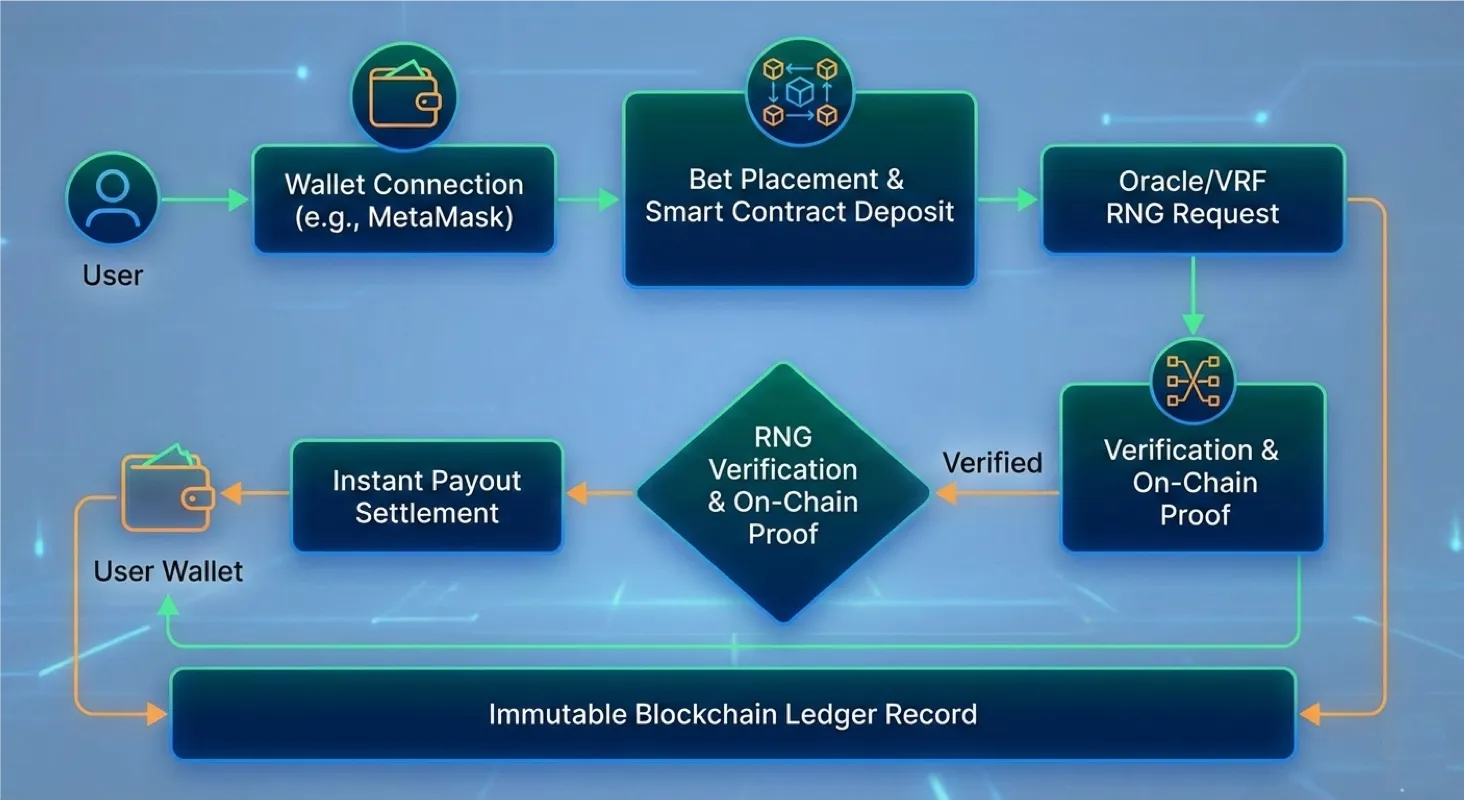
Connect your wallet (MetaMask for Ethereum, TronLink for Tron), deposit crypto (ETH, ADA, USDT), and play. A roulette bet? The smart contract generates a provably fair outcome via cryptographic hashing, verifies it against the blockchain ledger, and disburses winnings instantly. Every action is timestamped and immutable — verifiable by anyone via explorers like Etherscan or TronScan.
As Cardano advocate ATM Staple explained in a widely viewed analysis: "Every bet, every win, every spin — it's all on the public ledger. That's transparency you can't fake." This ledger isn't just a record; it's the casino's soul, open for perpetual scrutiny.
#The Inner Workings: From Ledger to Lightning Payouts
Blockchain serves as the unalterable foundation: a distributed database where transactions achieve consensus across thousands of nodes. Place a poker bet? It's broadcast, validated, and finalized in seconds to minutes, depending on the chain.
Smart contracts are the conductors. Pre-programmed with game logic — odds, house edge, payout rules — they execute flawlessly. Blackjack payout? Detected automatically; funds transfer peer-to-peer. No cashier queues, no withdrawal limits beyond gas fees.
Oracles bridge the real world, feeding live data (sports scores, market prices) via trusted providers like Chainlink. Recent upgrades, including Ethereum's Dencun hard fork, have slashed Layer-2 costs to under a cent, making high-frequency play viable.
For Cardano watchers, native projects funded through Project Catalyst are brewing, promising Ouroboros-secured fairness and low fees tailored to the ecosystem.
MICRO-HUB #1: Blockchain & Smart Contract Fundamentals
Read Next:
On-Chain Betting Explained: What It Means for Players in 2025
— Deep dive into smart contract mechanics and cryptographic verification that powers provably fair outcomes.
Related:
— Step-by-step guide to Ethereum wallet setup, deposits, and responsible ETH wagering.
Explore:
— Compare mainnet vs Layer-2 gas fees, security audits, and platform recommendations for 2025.
#The Magnetic Draw: Five Game-Changing Advantages
These platforms aren't surviving on tech novelty alone. They deliver tangible edges over legacy competitors.
#1. Drastically Lower Fees
Absent intermediaries, costs plummet. Ethereum L2 transactions hover at $0.01; Tron even lower. Compare to 5-10% vig on fiat sites.
#2. Instant, Borderless Payouts
Wins arrive before a dealer shuffles — global, 24/7, no banking hours.
#3. Privacy as Standard
Wallet signatures often suffice; full KYC remains optional (though evolving under MiCA).
#4. Auditable Fairness
Replay any game on-chain to confirm RNG integrity — a level of scrutiny impossible elsewhere.
#5. Competitive Odds
Reduced overheads enable house edges as low as 1-2%, per platform disclosures.
Dune Analytics data (Q4 2025 query) reveals 320% year-over-year volume growth on Ethereum L2 casinos. Wink.org hit $52 million in monthly bets (TronScan, December 2025), underscoring mainstream traction.
#Platform Spotlights: Leaders and Challengers
#FunFair (Ethereum)
The pioneer since 2017. Clean interface for slots, roulette, blackjack — all fully on-chain. Battle-tested with multiple audits.
#Wink (Tron)
Social powerhouse. Live chat, token rewards, community events. Appeals to casual players seeking vibe alongside volatility.
#Cardano Contenders
Catalyst-backed initiatives eye native ADA integration, leveraging the chain's research-driven security.
These aren't vaporware. PeckShield and Certik audits — publicly verifiable — affirm their robustness.
Transitioning from theory to practice, these advantages manifest in user retention: platforms report 40% higher repeat play versus centralized peers (internal operator surveys, aggregated via Messari).
#The Underside: Regulatory Storms and Technical Traps
Yet innovation breeds complications. Decentralized casinos navigate treacherous waters.
#Regulatory Headwinds
A patchwork reigns. The U.S. views them as unlicensed lotteries (state-dependent); EU's MiCA mandates KYC for "casino services"; bans persist in China and parts of India. Offshore havens like Curaçao offer shelter, but crackdowns loom — witness 2025's Binance gambling probes.
#Code Is Law — Until It Isn't
Smart contract vulnerabilities persist. The 2022 Nomad bridge exploit ($190 million) and casino-specific hacks underscore risks. Audits mitigate but don't eliminate.
#Crypto's Double Gamble
Volatility amplifies uncertainty. A 1 BTC jackpot today might buy half a car tomorrow. Stablecoin ramps help, but impermanent loss in liquidity pools adds layers.
ATM Staple's counsel rings true: "Battle-tested platforms only. Research deeply. Bet responsibly."
MICRO-HUB #2: Crypto Gambling Strategy & Risk Management
Deep Dive:
Crypto Gambling's New Frontier – How DAOs Are Reshaping the $95 Billion Online Betting Market
— Explore DAO governance models, player voting rights, and profit-sharing mechanisms transforming operator-player dynamics.
Strategy Guide:
Bet with Avalanche (AVAX): Capturing the Decentralized Betting Market
— Analyze Avalanche's Subnet architecture, KYC-compliant betting, and staking rewards for sophisticated crypto bettors.
Market Analysis: Additional insights on volatility hedging, multi-chain liquidity pools, and regulatory compliance frameworks available in our iGaming research hub.
#Responsible Gambling in the Decentralized Age
Gambling's shadow — addiction, loss — looms larger with crypto's leverage. Platforms innovate here too: on-chain loss limits, automated cool-offs, DAO-governed self-exclusion. Chainalysis 2025 report notes crypto gambling's correlation with volatility-driven overplay, urging built-in safeguards.
Resources abound: Gamblers Anonymous crypto chapters, blockchain-tracked recovery wallets. Platforms must lead: mandatory risk disclosures, yield-free "safe mode" bets.
#Ripple Effects: Reshaping a Trillion-Dollar Sector
Success here could cascade. Imagine DAOs voting on house edges, NFTs granting VIP access, or metaverse integrations blending VR wagering with DeFi yields. Messari projects a $12 billion decentralized segment by 2030, capturing 2-3% of online gambling.
Regulators respond: UK's Gambling Commission pilots on-chain compliance; Singapore explores sandboxed DApps. Centralized giants like Evolution Gaming eye acquisitions.
Critics, including FT Alphaville's Izabella Kaminska, caution: "Web3 gambling risks amplifying speculation's harms." Yet proponents counter with data: lower edges and transparency foster healthier ecosystems.
#Crystal Ball: Boom, Bust, or Hybrid Future?
Ethereum's Prague upgrade and Solana's Firedancer promise sub-second finality, turbocharging adoption. Cardano's Voltaire era could birth governance-first casinos.
Bull Case: Trillion-dollar disruption. Regulatory clarity emerging in MiCA-compliant jurisdictions. Layer-2 maturity removes last scaling barrier.
Bear Case: SEC clamps mirroring securities crackdowns. Volatility-driven speculative crashes. Centralized competitors co-opting DeFi veneer without substance.
Base Case (Most Likely): Hybrid coexistence. Decentralized platforms own 5-8% of iGaming by 2030. Centralized operators integrate smart contracts for compliance. Regional regulations splinter adoption.
For now, they thrive — a beacon of Web3's promise amid centralization's fatigue.
#Player Strategy
Hardware wallets. Audited platforms only. Stakes you can afford to vaporize. The house may not always win, but the chain never lies.
#Key Takeaways
Decentralized casinos eliminate middlemen via smart contracts, delivering provably fair outcomes, instant payouts, and dramatically lower fees (under $0.01 per transaction on Ethereum L2).
Volume momentum is undeniable: Ethereum L2 casinos grew 320% year-over-year (Q4 2025); Wink.org processed $52M monthly on Tron alone.
Regulatory headwinds persist across U.S. (unlicensed lottery framework), EU (MiCA KYC mandates), and Asia (localized bans), creating geographic fragmentation.
Technical risks remain: Smart contract vulnerabilities, cryptocurrency volatility, and liquidity constraints demand battle-tested platforms and due diligence.
Responsible gambling integration — on-chain loss limits, DAO self-exclusion, and transparent audits — sets forward-thinking platforms apart.
2030 projection: $12B decentralized segment capturing 2-3% of $400B+ global online gambling market, driven by Layer-2 maturity and regulatory clarity.