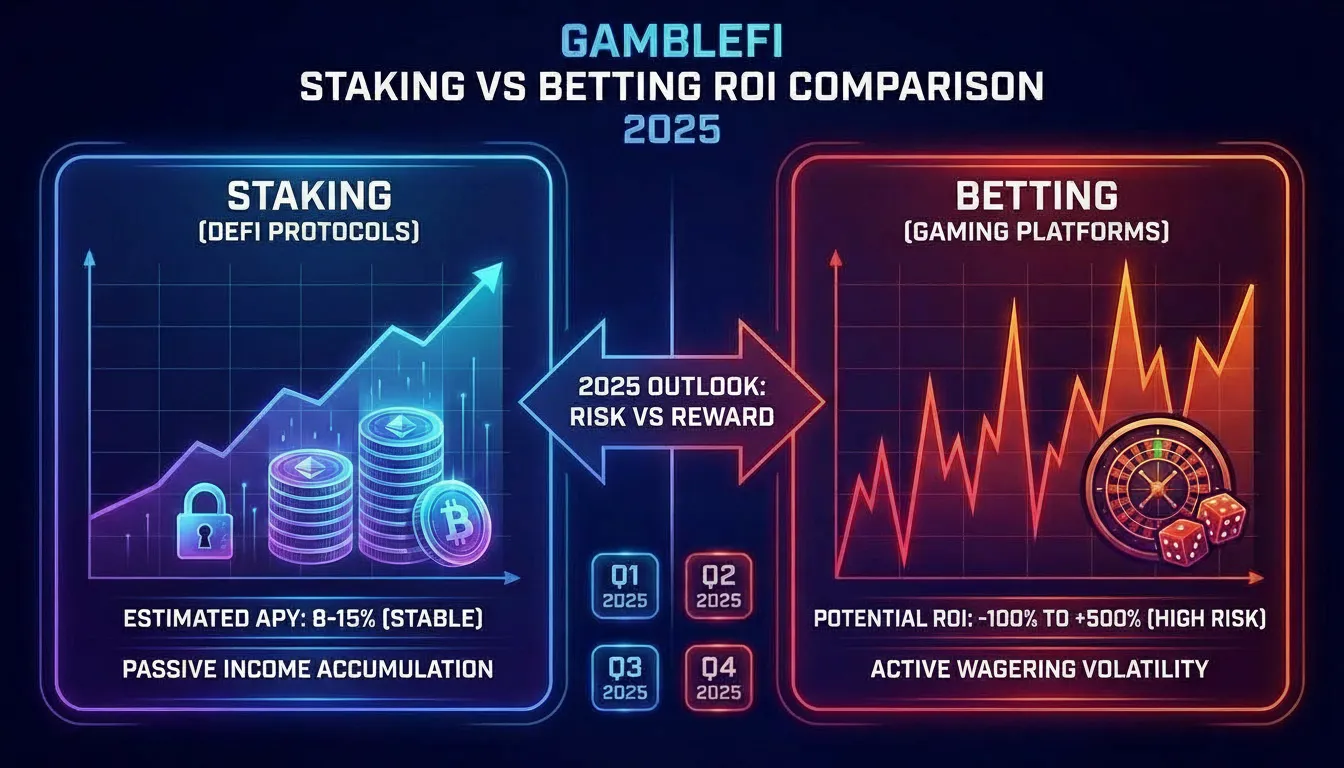
#Staking vs. Betting: Comparing the ROI of Holding Casino Tokens vs. Playing the Games
In the shadowy intersection of blockchain and high-stakes gambling (known as GambleFi), investors confront a deceptively simple dilemma: park their tokens for steady, if unglamorous, yields, or plunge them into the games for the thrill of instant riches? Platforms like Rollbit and Shuffle have turned this choice into a multimillion-dollar calculus, where staking casino tokens can deliver 10 to 30 percent annual returns through revenue shares and token burns, while betting pits players against house edges as slim as 1 percent in elite games. As GambleFi's total value locked nears $1 billion in late 2025, the stakes could not be higher for those blending DeFi discipline with casino adrenaline. For discerning investors, the real question is not which path pays more, but how to navigate both without courting ruin. ValueTheMarkets explores top crypto gaming coins for 2025 where such dynamics drive explosive growth.
#The Mechanics of Yield: Passive Stakes Against the House
At its core, return on investment in casino tokens diverges sharply between the quiet persistence of staking and the volatile pulse of betting. Staking casino tokens locks them into smart contracts or liquidity pools, harvesting a slice of platform revenues. Rollbit, for instance, funnels 30 percent of profits into RLB buybacks and burns, having eliminated much of its supply by midyear. FUNToken offers structured yields up to 9.9 percent across 15- to 90-day terms, while emerging projects like Rollblock promise weekly revenue shares alongside AI-tuned returns as high as 30 percent annually. These are not speculative moonshots but systematic claims on the house's perpetual vig, akin to a silent partnership in the casino's backroom ledger.
Betting, by contrast, is governed by return to player (or RTP), the theoretical percentage of wagers returned over infinite spins. A 97 percent RTP slot repays $97 for every $100 bet in the long run, leaving a 3 percent edge for the operator. Crypto casinos push this boundary, with titles exceeding 99 percent in rare cases, though variance reigns supreme: a high-volatility game might starve a bankroll for hours before unleashing a 500-fold payout. Traditional fiat houses mirror these odds but without the token upside; Web3's innovation lies in hybrid models, where staking multipliers extend playtime or amplify rakeback.
Metric | Staking | Betting |
Estimated Annual Yield | 10-30% (revenue-tied) | 96-99% RTP (long-term) |
Risk Profile | Low to moderate (platform risk) | High (variance + edge) |
Liquidity | Locked periods | Instant access |
Break-Even Horizon | Compounding over months | Millions of spins |
From this trading desk, the table reveals staking's edge in predictability. House profits flow inexorably to holders, unmarred by lady luck.
#Real-World Reckonings: Rollbit and Beyond
Consider a $10,000 allocation to Rollbit's RLB in January 2025. Staked casino tokens at an average 20 percent APY compound to $12,000 by year-end, bolstered by daily burns equivalent to tens of thousands in token value. Rakeback scales with holdings: $100 might yield 2 percent, while larger stakes climb to 10 percent of the house edge, all without a single spin. FUNToken's $5 million rewards pool similarly auto-distributes Ethereum yields at price milestones, filling on a first-come basis for disciplined holders.
Now flip to betting: Deploy that $10,000 on Rollbit's 97 percent RTP roulette. Over high volume (say, 100,000 spins), theoretical returns hit $9,700, a 3 percent erosion. But variance strikes hard; a cold streak could halve the stack in hours, even as jackpots tempt. Shuffle's originals, with 96-99 percent RTPs, fare better for grinders, yet the house always collects. Hybrid tacticians shine: Stake the bulk for yields, then wager welcome bonuses (Rollblock's 100 percent matches) on low-edge plays, preserving capital while chasing upside. Empirical math favors the staked core: Passive holders capture the full edge systemically.
#From Vegas to the Blockchain: Web2's Shadow, Web3's Dawn
Legacy casinos (Vegas strips or online fiat giants) hoard their 2-5 percent sports vig and 4-10 percent slot margins, offering players nothing beyond comped drinks. KYC hurdles, sluggish payouts, and zero equity stake define the old guard. Web3 upends this: Casino tokens redistribute the edge via staking shares, deflationary mechanics, and even governance votes on game parameters. Bitcoin houses bridge the gap with speed but miss native accruals; full GambleFi platforms like Rollbit turn bettors into proprietors.
The migration accelerates. A large percentage of crypto slots enthusiasts now prioritize high-RTP volatility, their sessions stretched by staking perks. Dual-token designs emerge, separating utility from governance to fine-tune yields. For investors, Web3 is not mere novelty; it systematizes what fiat operators monopolized for decades. ValueTheMarkets charts this evolution in Web3 gaming to crypto casinos.
#Portfolio Discipline: Crafting the Winning Blend
Armed with these dynamics, allocation demands precision. Anchor 70-80 percent in staking casino tokens across diversified tokens (FUN for stability, RLB for aggression), targeting 15-25 percent blended APY. Deploy the rest into vetted bets: 97 percent-plus RTP slots or sub-2 percent vig sports lines, fueled by bonuses to blunt the edge. Dollar-cost into burn events during dips; track TVL-to-revenue ratios as yield sentinels. Risks shadow every move: Smart contract exploits could vaporize stakes; betting streaks amplify drawdowns in crypto winters; regulatory clouds gather over gambling tokens.
Tax implications vary. Staking often counts as income, wins as capital gains. Limit GambleFi to 5-15 percent of portfolios as high-beta DeFi, audited ruthlessly. In bear phases, staking weathers storms; bull runs supercharge both.
#Horizons Ahead: GambleFi's Maturing Frontier
GambleFi hurtles toward a $5 billion TVL by 2030, propelled by AI risk engines, prediction markets, and metaverse lounges. Staking's primacy solidifies as revenues scale, outstripping betting's capped RTPs (now nudging 99.5 percent in labs). Pro-crypto regimes promise broader access, though volatility and oversight persist. Play-to-earn evolves from games to casinos, rewarding holders with 10-20x sector multiples in optimistic scenarios. Discover emerging crypto betting trends for 2025 shaping this frontier.
#Stake with Foresight, Wager with Restraint
Staking casino tokens prevails for enduring ROI, methodically reclaiming the house edge as compounded yields while selective betting injects calibrated thrill. The optimal path hybrids the two: Hold firm for systemic profits, play smart on the margins. As GambleFi cements its place in Web3's pantheon, favor audited leaders. Conduct your due diligence, diversify deliberately, and claim your share of the boom. Figures estimated as of December 2025; markets evolve rapidly. Verify independently.