#Smart Contract Audits 101: How to Read a CertiK Report Before Depositing Into a DeFi Casino
In the high-stakes world of decentralized finance, where DeFi casinos lure investors with promises of instant payouts, provably fair games, and tokenized rewards, a single unchecked smart contract can evaporate fortunes overnight. CertiK's Hack3d report for the first half of 2025 documented $2.47 billion in Web3 losses across 344 incidents, many tied directly to exploitable code in DeFi protocols—highlighting the razor-thin margin between windfall wins and catastrophic losses. For the discerning investor eyeing crypto betting platforms like those powered by Solana or Ethereum, mastering CertiK audit reports offers a rigorous defense. These dense technical documents, often spanning dozens of pages, transform into actionable intelligence when decoded properly, empowering you to commit capital with confidence. This comprehensive guide, drawn from years of tracking blockchain exploits and dissecting hundreds of audits, equips you to navigate these reports with precision and avoid the pitfalls that have sunk lesser-prepared players. Explore related insights on DeFi Gambling Guide for practical tips on yield farming your betting bankroll in these volatile environments.
#The Stakes in DeFi Gambling's Rapid Ascent
The crypto gambling sector has undergone explosive growth, surging from a modest $50 million in daily trading volume in 2019 to a robust $250 million by 2024, with industry forecasts projecting $400 million by 2028. This meteoric rise is propelled by cutting-edge innovations such as token staking for passive yields, on-chain roulette with verifiable randomness, cross-chain liquidity pools, and integration with layer-2 scaling solutions for near-instant settlements. Yet, beneath this glittering surface, vulnerability endures like a hidden house edge. Halborn's comprehensive data reveals that only 20% of hacked DeFi projects had undergone prior audits, accounting for just 10.8% of total losses, while unaudited code bore the overwhelming brunt of exploits—leaving billions in player funds exposed.
Traditional fiat casinos, shackled by centralized licenses and opaque random number generators (RNGs), obscure their inner workings behind regulatory veils and proprietary black boxes. DeFi flips this script entirely, mandating radical transparency through public audits like CertiK's meticulous line-by-line code reviews. These audits probe for insidious flaws such as reentrancy vulnerabilities, integer overflows, oracle price manipulations, and front-running attacks—threats virtually absent in Web2 silos but rampant in permissionless blockchains. In iGaming's seismic shift to Web3, this level of scrutiny isn't a luxury; it's raw survival. Consider Q3 2025 alone, when scams and exploits exceeded $750 million, underscoring how even audited platforms must evolve amid sophisticated attackers. See how NFT Integration in Gambling is layering unique digital assets onto these platforms, further blurring lines between gaming and investment.
#CertiK's Skynet Score: Your First Line of Inquiry
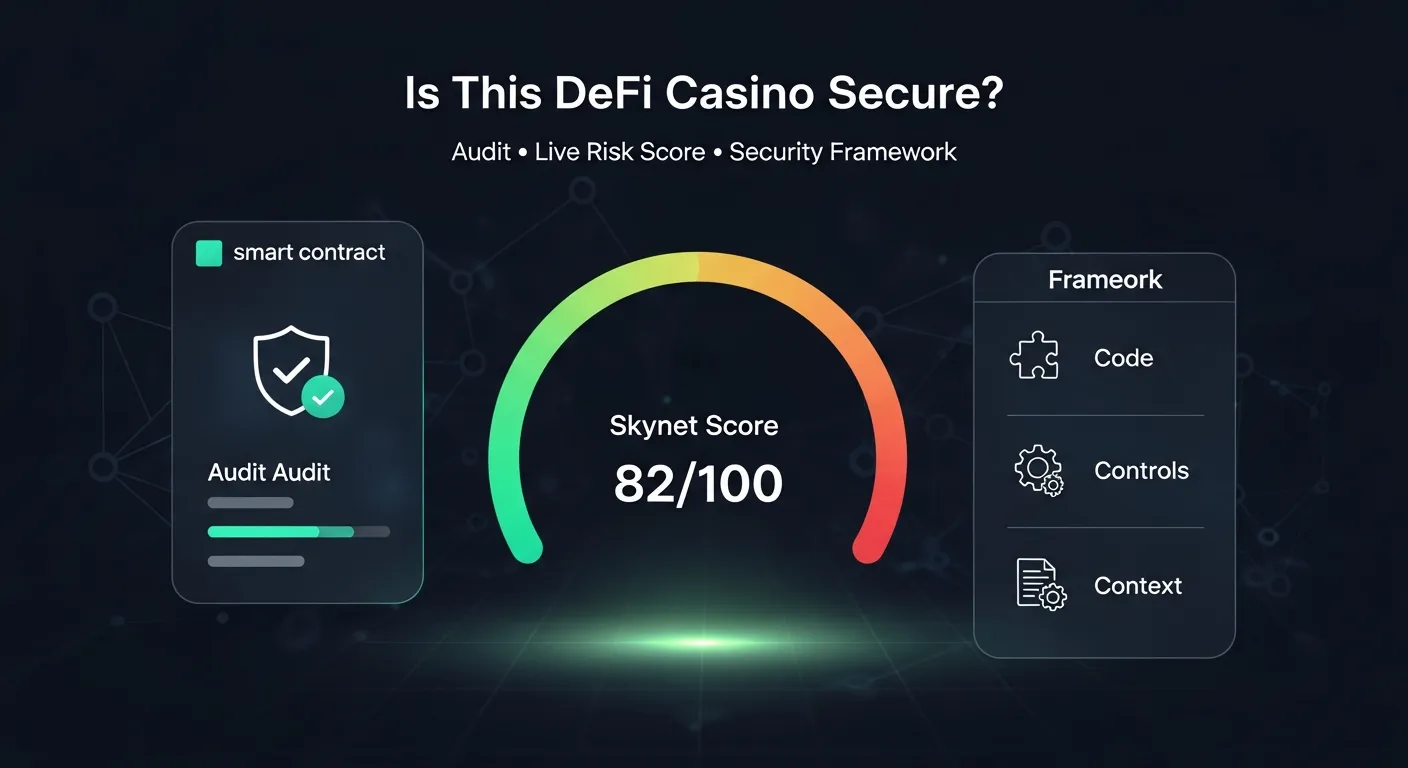
At the vanguard of this security ecosystem stands CertiK's Skynet Score, a sophisticated 0-100 composite metric synthesized from over 15 distinct signals spanning six critical pillars: code security, operational health, community trust, market stability, governance strength, and fundamental robustness. This at-a-glance barometer delivers an instant verdict on a project's resilience—scores above 85 flag battle-tested protocols worthy of consideration, while elite performers like Uniswap hover near the perfect 100 on CertiK's DeFi leaderboards. Conversely, sub-80 scores demand immediate caution, especially for high-velocity DeFi casinos juggling volatile bets, leveraged positions, and real-time liquidity events.
As a seasoned blockchain observer who has borne witness to seismic events—from the Ronin Network's staggering $600 million validator breach to 2025's $1.71 billion in wallet drains via private key compromises—I treat persistently low Skynet ratings as absolute non-starters. Real-time on-chain tracking, a cornerstone of Skynet's methodology, exposes insidious post-audit drifts: sudden centralization spikes in token holdings, unresolved Common Vulnerabilities and Exposures (CVEs), or anomalous transaction patterns signaling insider risks. For DeFi casinos, where user funds mingle in shared pools, a dipping score often precedes outflows—investors who ignore this do so at their peril.
#A Methodical Guide to Dissecting the Report
Embark on your audit deep dive at CertiK's intuitive Security Leaderboard: simply search for the target DeFi casino, peruse its audit history, and download the comprehensive PDF report. To streamline this forensic process, apply our proprietary 3C Framework, distilled from real-world dissections of dozens of reports:
Criticals Check: Enforce zero tolerance for existential fund-theft risks like reentrancy attacks or arbitrary code execution; rigorously scan the Vulnerability Summary for any unfixed Critical or High-severity issues, which could enable total protocol drainage.
Codebase Alignment: Meticulously confirm the audit's scope—specific contracts audited, Solidity compiler version, deployment blockchain (Ethereum mainnet, Solana, etc.)—precisely matches the live deployment verifiable via GitHub commit hashes and Etherscan explorers.
Continuity Verification: Scrutinize the Findings section for detailed exploit descriptions, potential impacts (e.g., "infinite minting drains liquidity pool"), and proposed remediations. Demand "Alleviated" status backed by code diffs, independent tester sign-offs, and evidence of re-audits or formal verification.
Each finding meticulously outlines the vulnerability's mechanics, real-world exploit paths, and mitigation strategies—always cross-reference with blockchain explorers like Etherscan or Solscan for deployment proofs and on-chain verification. This disciplined approach mirrors the forensic due diligence of Wall Street quants analyzing derivatives, ensuring no stone goes unturned. For real-world platform examples emphasizing no-KYC security, check Best Crypto Casinos 2025.
#Red Flags Tailored to Casino Protocols
DeFi casinos, with their dynamic betting pools and oracle-dependent odds, amplify a rogues' gallery of common pitfalls: reentrancy attacks enabling recursive drains (implicated in 30% of historical exploits), unchecked external calls precipitating 59% of input validation failures, and flash loan manipulations that warp betting odds in milliseconds. Improper access control gaps eerily echo Ronin's validator catastrophe; meanwhile, oracle feeds crumble under sophisticated price spoofing. Benchmark against Skynet's DeFi peers—Aave consistently at 90+ versus Q1 2025's grim tally of 197 hacks pilfering $1.6 billion.
Audited vs. Hacked DeFi Casinos | Audited (Skynet 85+) | Hacked (Low/No Audit) |
H1 2025 Loss Share | <10% of incidents | 80%+ of $2.47B total |
Top Flaws | Mitigated reentrancy, access controls | Oracle exploits, flash loans |
Recovery Odds | 40-60% via insurance funds | Near zero post-drainage |
TVL Stability Post-Incident | Steady inflows, resilient | 70%+ immediate drop |
#From Web2 Opacity to Web3 Accountability
Legacy Web2 casinos perpetuate opacity, veiling an estimated $81.4 billion U.S. shadow gambling underworld in 2024 behind static licenses and unverifiable RNGs. DeFi radically inverts this paradigm: immutable smart contracts invite perpetual public audits, fortified by CertiK's formal mathematical verification, ongoing bug bounties, and AI-driven anomaly detection—yet H1 2025's $3.1 billion in smart contract losses grimly affirm that even gold-standard audits demand relentless dynamic monitoring.
#Safeguarding Bets in an Evolving Landscape
"Self-vetting via Skynet isn't optional—it's your house edge in DeFi's unforgiving arena." —Blockchain analyst maxim.
Looking ahead, virtual reality interfaces are poised to capture 20% of crypto bets by 2026, while AI-enhanced oracles and mandatory multi-signature wallets herald a new era of fortified protocols. Verify live metrics at skynet.certik.com, deploy the 3C checklist religiously, and stake with surgical precision. In this maturing frontier, informed scrutiny alone will anoint enduring platforms amid the wreckage of fleeting gambles. Dive deeper into token-specific analysis with Best Crypto Gambling Tokens 2026 covering DICE, BCG, and RLB