#Ethereum Betting Sites 2025: ETH vs Layer-2 Solutions
#Introduction: From Gas Shock to Layer-2 Lift-Off
March 2025, Las Vegas. Jake Reynolds, a longtime sports bettor and self-styled “on-chain sharpshooter,” watched a last-minute three-pointer save his parlay—and realized the $17.42 he’d paid in Ethereum gas fees had left him net negative on a $35 win. “It felt like the house edge was baked into the blockchain itself,” he quips. Far from an isolated gripe, Jake’s story reflects the rising tension facing countless gamblers and platform operators.
For all its legacy as crypto gambling’s backbone, Ethereum’s mainnet is being outflanked by next-generation Layer-2 chains, slashing costs, opening access, and forcing global regulators to redraw the industry map. The future of ETH gambling—and the risks for casual and “whale” bettors alike—now hinges on this Layer-2 revolution.
#From Mainnet to Layer-2: Gas Fees, Speed, and User Survival
#The 2025 Fee Reality: What Bettors Actually Pay
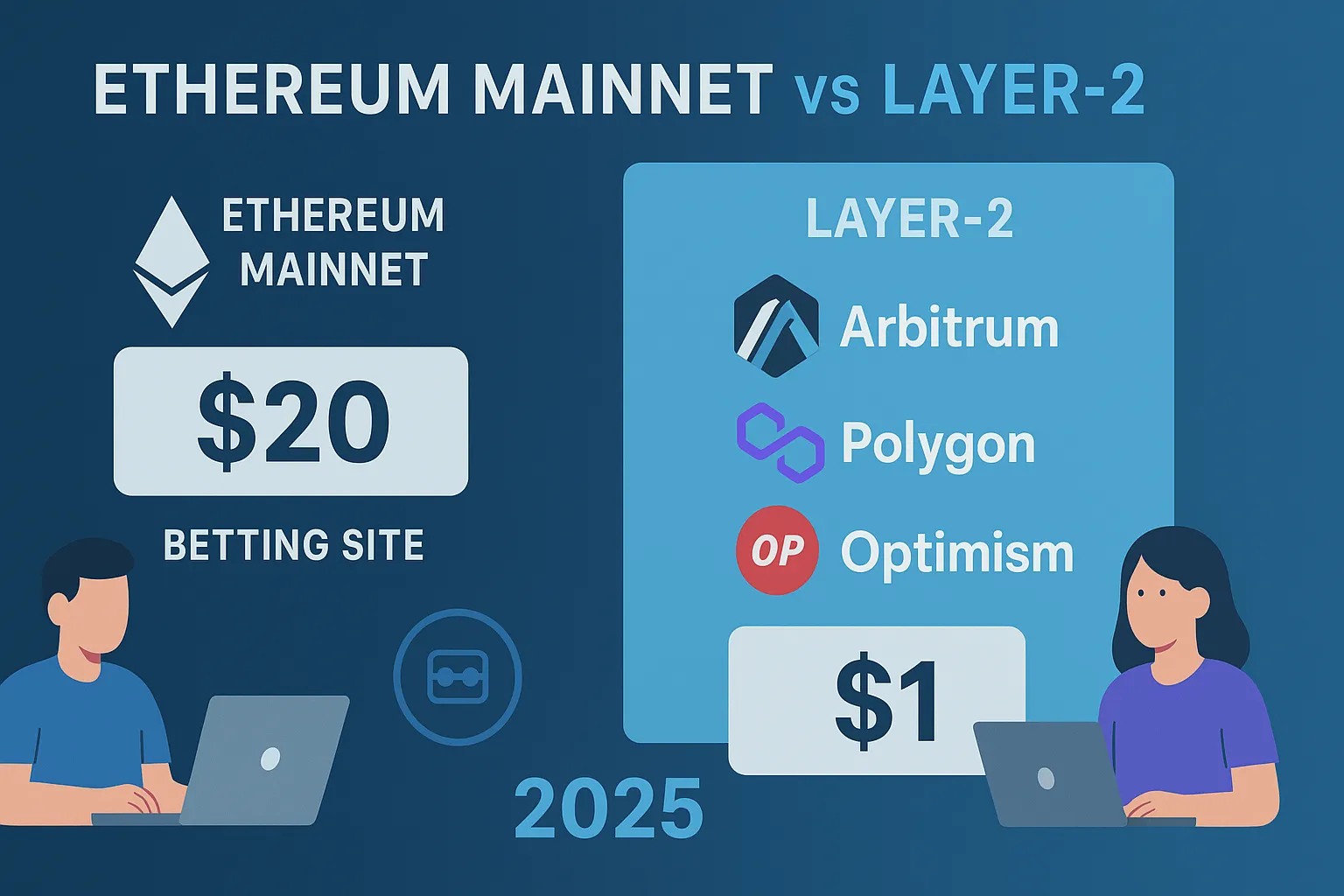
Mainnet ETH: Median on-chain betting fee in 2025—$3.78 per action, but surging to $20+ during “hot” sports weekends or token launches. For micro-bets, it’s often a losing proposition.
Layer-2 (Arbitrum, Polygon, Optimism): Transactions routinely settle for less than $0.01—regardless of network pressure. Micro-bettors report “no sweat” play, frequent cash-outs, and the ability to reload instantly, without feeling penalized for high frequency.
#First-Person: Micro-Bettor Migration
Toronto-based crypto gamer Linh Duong says she “switched to Polygon after seeing nearly a tenth of every bet vanish in mainnet gas last NHL season.” For esports, arbitration, and rapid-fire prop betting, she praises near-zero friction: “It’s the first time my betting strategy isn’t dictated by blockchain fees.”
Platform | Average Fee (2025) | User Experience Summary | Transaction Speed |
Ethereum | $3.78–$17.42 | Slow, high cost; whales persist | 30 sec–5 min |
Arbitrum | <$0.01 | Fast, seamless, micro-bet friendly | <10 sec |
Polygon | <$0.01 | Gaming focus, good for streaks | <10 sec |
Optimism | <$0.01 | Tech-forward, growing fast | <12 sec |
“Layer-2 chains didn’t just lower the fees—they changed who could play, how fast, and how much you can win.”
— Ramona Depares, crypto sports betting analyst
#Smart Contracts and Security: An Operator’s Eye View
#Trust, Compliance, and the Reality Check
ETH’s mainnet and Layer-2s now power a new breed of “smart contract casinos” and DeFi sportsbooks. These platforms automate payouts, lock in odds pre-match, and turn platform trust into a public, auditable record. Unlike the “code-says-who-wins” mystique of early DApps, today’s smart contract sportsbooks offer:
Provable Fairness: All outcomes, wagers, and house odds can be publicly inspected.
RNG Integrity: Most leading sites now integrate third-party verified Random Number Generators, with transparent audit histories, to qualify for new regional licenses.
On-Chain Compliance: Several operators embed KYC and AML directly in wallet onboarding—removing the “untraceable wallet” loophole regulators flagged in years past.
#Operator Perspective: Cost and Compliance
BC.Game CTO Mike Gates comments: “Every compliance audit hits harder now. We’re layering AI-based KYC on Arbitrum, publishing live audit feeds, and using Polygon’s bridges to fund player pools instantly.” This approach, he notes, has dropped their compliance review cycle from thirty days to less than a week, “and 50% of our new user growth comes from L2-only bettors.”
#The Global Regulatory Battleground: Where Can You Bet Legally?
#North America
United States regulation remains a patchwork:
Some states allow ETH and Layer-2 betting, with full KYC and strict age controls.
Others, like New York and Texas, ban crypto sportsbooks outright, pushing users to off-shore L2 platforms.
Canada, meanwhile, allows more open access but is moving toward mandatory registration and AML on high-velocity crypto betting.
#European Union
The EU under MiCA (Markets in Crypto Assets) in 2025 has delivered the most sweeping reform:
Mandatory casino licensing, registration, and on-chain auditability.
Anyone betting from the EU must pass KYC (no more anonymous “whale” activity on regulated sites), and every platform must report suspicious transactions in real time.
#Asia-Pacific, LatAm, and MENA
Explosive user growth, especially among mobile-first and esports bettors.
Layer-2 platforms are favored for cross-border access and for circumventing fiat ramp restrictions. However, unregulated operators face increasing clampdown, with rising geo-blocks and payment blacklists.
#Case Studies: Leading Platforms, Real Outcomes
#The $3 Million Winner—and the Mainnet Paradox
In August 2024, a single Fomo3D jackpot, paid in ETH, netted a player just under $3 million. The winner reportedly spent 40–50 ETH gaming the blockchain—timing gas fees and block congestion perfectly to edge out not only rivals, but also high-frequency bots. It was both a masterclass in strategy and an advertisement for Layer-2’s promise: “On Polygon, closeouts happen so fast this sort of block-gaming would be functionally impossible,” observes iGaming risk consultant, Yelena Karpov.
#L2 Success Story: Arbitrum in the Lead
Arbitrum now processes over 2.16 billion transactions, with $19.2 billion in Total Value Locked and 1.45 million monthly active users as of September 2025—up 330% from 2024.
On platforms like Oddz Protocol and Polygamble, 80%+ of new sportsbook signups choose an L2 wallet during registration, citing “lightning” cashouts, social betting, and “no more gas shock” user experience as primary draws.
Platform | Networks Supported | User Highlight | Licensing & Audit |
| ETH, L2 (multi-chain) | VIP staking, esports props, chatroom | Curacao, live RNG |
CoinCasino | ETH, BSC, Polygon | Large bonuses, wide sports coverage | UKGC, AI audit |
Vave | Arbitrum | Bridge-less L2 signup, instant pools | MGA, provably fair RNG |
#User Behavior Shifts 2025: Data-Driven Insights
Micro-betting (sub–$10 bets, live/in-play wagers) now accounts for 70%+ of total volume on L2’s, up from less than 30% in 2023.
“Whale” bettors (over $5,000 per ticket) remain attached to mainnet for perceived “maximum integrity” on multi-million-dollar parlays.
Social betting and “squad pools” surge on Polygon and Optimism, leveraging super-low fees and fast bulk payout features.
Real-money casino onboarding time has dropped from ~14 minutes (ETH mainnet, high gas) to under 2 minutes on most L2-first sites, driving higher retention after registration.
#Responsible Gambling, Licensing, and EEAT Safeguards
Legal & Licensing:
All featured operators are licensed in at least one reputable jurisdiction (Curacao, MGA, or UKGC) and publish live or quarterly RNG audits. Never wager on platforms without current licenses and transparent regulatory data.
Responsible Gambling Tools:
Deposit limits, self-exclusion, and cool-off periods are now standard—on-chain. The EU and many North American states require visible “play responsibly” warnings, and most operators use blockchain-powered verification to prevent underage play and flag suspicious activity.
Editorial Note:
“Gamble with your head—not just your wallet. In 2025, transparent platforms empower bettors to monitor risk, set boundaries, and step away.”
— Editorial Board, Responsible Gambling Council
#FAQ: Ethereum & L2 Gambling in 2025
Question | Expert Answer |
Are Layer-2 casinos as safe as mainnet? | Yes, leading L2s inherit Ethereum security via rollups |
Can I gamble anonymously? | No, not on regulated sites; robust KYC is mandatory |
How much can Layer-2 save on fees? | $3–$17+ per bet, often much more on heavy bet days |
What’s the best ETH betting platform now? | Top choices: BC.Game, CoinCasino, Vave, Polygamble |
Are winnings instant on Layer-2? | Yes, all smart contract platforms automate payouts |
Can US users access L2 sportsbooks? | Varies by state; check local laws before wagering |
#Insider’s Perspective: What’s Next for ETH Gambling?
“Ethereum Layer-2s are evolving from a cost play to a user experience revolution. Expect sports prop bets, on-chain pools, and even cross-chain wagering to blur the old lines of the iGaming space—if regulators can keep pace,” says Richard Teng, CEO of Binance, in a recent CNBC interview. “The real winners in 2025 will be platforms that blend transparency, fairness, and unmatched speed. Those gambling on old infrastructure will feel left behind.”
#Conclusion: The Shape of Betting to Come
Ethereum betting sites in 2025 reflect the industry’s march toward transparency, affordability, and rapid evolution. Layer-2 technology is now more than a solution to gas fees—it’s an open invitation to new forms of play, deeper pools, and regulatory innovation across borders. The next era belongs to users and operators who adapt quickly, prioritize compliance, and never forget the risks—nor the promises—at the heart of every wager.
Will the relentless pace of Layer-2 adoption finally neutralize mainnet’s dominance, or will legacy and innovation permanently coexist? The dice are rolling—where will you stand when they land?