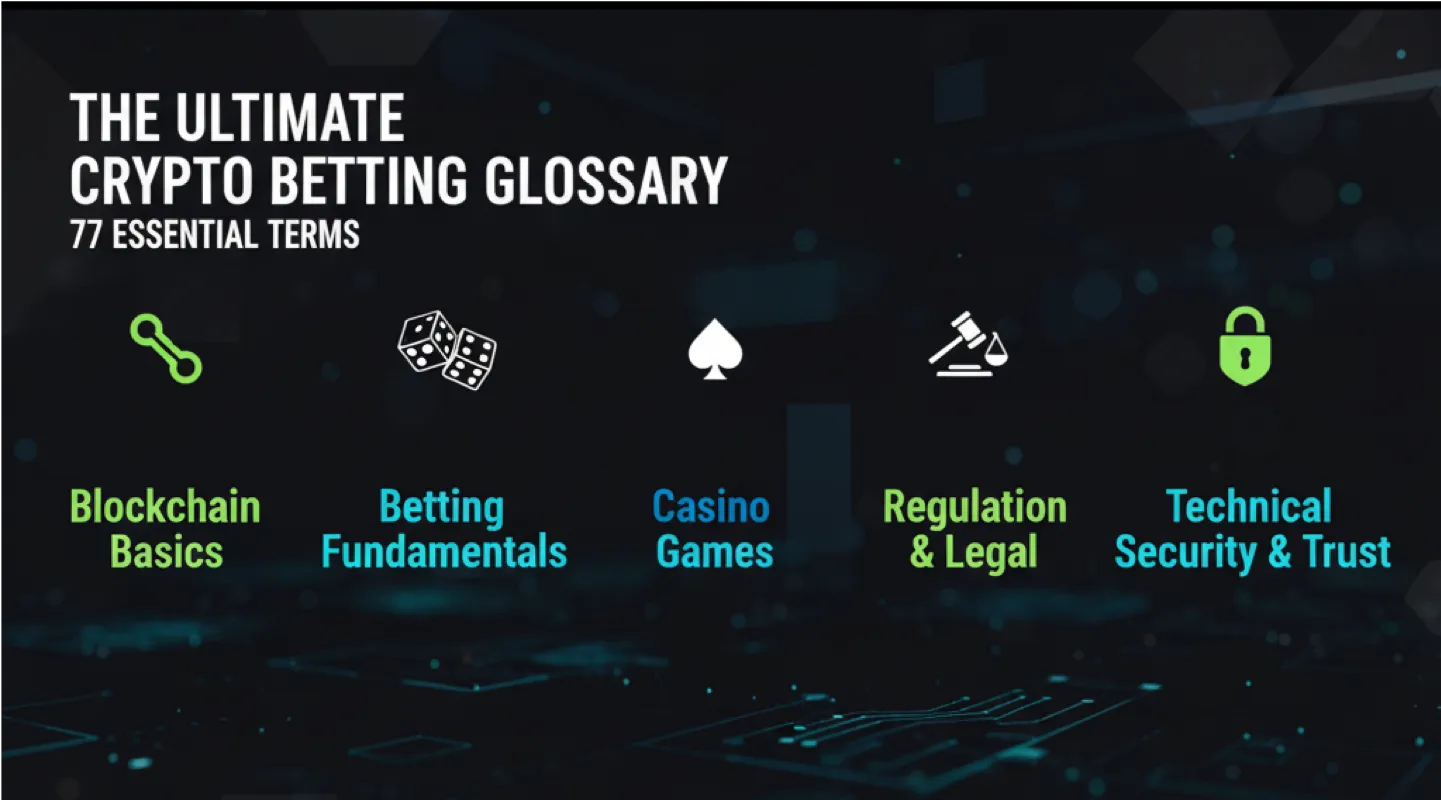
#Crypto Betting Glossary: 77 Terms Every Gambler Should Know
From "provably fair" to "liquidity pool" to "house edge"—your complete crypto gambling dictionary.
#INTRODUCTION
The world of cryptocurrency betting operates in its own language. Terms from blockchain technology mix with centuries-old gambling vocabulary, regulatory jargon sits alongside innovations that didn't exist five years ago. You'll encounter words like "provably fair" and "smart contract" in one sentence, then see "parlay" and "RTP" in the next.
Whether you're a seasoned trader exploring crypto sportsbooks or a newcomer placing your first bet in Bitcoin, understanding this terminology isn't optional—it's foundational. A misunderstood term can cost you money. A missed concept can expose you to security risks. Worse, a fuzzy understanding of regulatory frameworks can land you on the wrong side of the law.
This glossary serves two purposes. First, it's a reference guide. Jump to the terms that matter to your betting style, use the categories to navigate, come back when you hit unfamiliar jargon. Second, it's a learning tool for readers who want to deepen their understanding of how crypto betting actually works beneath the marketing speak.
Terms are organized by category for accessibility, then alphabetical within each section. Each entry includes a definition, real-world example, and explanation of why it matters when risking real money.
#BLOCKCHAIN & CRYPTOCURRENCY TERMS
#Altcoin
Definition: Any cryptocurrency other than Bitcoin. Ethereum, Litecoin, Dogecoin, Monero, and Tether all qualify as altcoins.
Example: Most major crypto sportsbooks accept Bitcoin and Ethereum, but some players prefer altcoins like USDT for faster settlement and lower fees.
Why it matters: Different coins process transactions at different speeds and costs. A crypto betting site accepting altcoins gives you options—critical if you need speed or privacy features specific to certain coins.
#Bitcoin (BTC)
Definition: The first cryptocurrency, created in 2009 by an anonymous person or group under the pseudonym Satoshi Nakamoto. Bitcoin is the most widely accepted digital currency at crypto betting sites.
Example: A player deposits 0.5 BTC into a sportsbook, places bets, and can withdraw winnings in Bitcoin within minutes.
Why it matters: Bitcoin's global liquidity and widespread adoption make it the default for crypto betting. Its long transaction history also makes it the benchmark for comparing how newer coins perform.
#Blockchain
Definition: A distributed ledger technology that records all transactions across a network of computers. Each "block" contains transaction data, and blocks are "chained" chronologically, making records immutable and transparent.
Example: When you withdraw winnings from a crypto casino to your wallet, that transaction gets recorded on the blockchain—verifiable by anyone with the right tools.
Why it matters: Blockchain is the infrastructure that makes crypto betting possible. It enables fast settlements, transparent record-keeping, and eliminates intermediaries like banks and payment processors. Understanding this foundation clarifies why crypto betting differs from traditional online gambling.
READ MORE: Blockchain Online Gambling: Faster Payouts & Provable Fairness
#Custody (Self-Custody)
Definition: The practice of holding your own private keys and maintaining direct control of your cryptocurrency assets, rather than storing them on an exchange or third-party platform.
Example: Storing your Bitcoin in a hardware wallet like Ledger is self-custody. Leaving funds on a crypto exchange is not—the exchange technically holds custody.
Why it matters: Self-custody reduces counterparty risk—if the betting site gets hacked or shuts down, your coins in a personal wallet remain yours. It's also essential for responsible gambling: funds you control are harder to impulsively lose.
#Decentralized Application (dApp)
Definition: An application that runs on a blockchain network using smart contracts, with no central server or authority controlling its operation.
Example: A provably fair dice game built on Ethereum where all outcomes are determined and recorded by smart contract code, not by a company's servers.
Why it matters: dApps offer the transparency crypto betting platforms promise—no hidden RTP adjustments, no selective odds changes. Everything is auditable on-chain. However, dApps remain a niche product compared to traditional crypto casinos.
#Ethereum (ETH)
Definition: The second-largest cryptocurrency and a blockchain platform that enables smart contracts and decentralized applications. Ether (ETH) is its native digital currency.
Example: A hybrid crypto sportsbook accepts both Bitcoin and Ethereum deposits, with Ethereum deposits often clearing faster due to lower network congestion.
Why it matters: Ethereum dominates the landscape for token transfers and smart contract operations. Many emerging crypto betting platforms are built on Ethereum or Layer 2 Ethereum networks (like Arbitrum or Polygon), meaning ETH is often the cheapest way to deposit or withdraw.
READ MORE: Bet with Polkadot (DOT): Why DOT Could Be the Future of Crypto Gambling
#Hash / Hashing
Definition: A cryptographic function that converts any input data into a fixed-length string of characters. The same input always produces the same hash, but changing one character of input completely changes the hash output.
Example: In provably fair systems, the casino hashes its secret "server seed" before play begins. After the game, it reveals the original seed, and you verify its hash matches what was shown pre-game.
Why it matters: Hashing is the mathematical backbone of provably fair gambling. It's how casinos prove they didn't cheat—the hash acts as a digital fingerprint that can't be forged.
#Liquidity Pool
Definition: A collection of cryptocurrency tokens locked in a smart contract, allowing decentralized exchanges to function. Users deposit paired assets (like ETH and USDC) and earn fees from trades passing through the pool.
Example: An emerging crypto sportsbook rewards loyal players with LP tokens representing their share of a liquidity pool. When the platform grows, the pool generates trading fees, creating additional income for token holders.
Why it matters: Some advanced crypto betting platforms use liquidity pools to manage odds or reward players. Understanding how they work helps you evaluate whether platform incentive structures are sustainable.
#Monero (XMR)
Definition: A privacy-focused cryptocurrency that obscures transaction senders, receivers, and amounts on the public ledger, providing anonymity unavailable with Bitcoin.
Example: A few offshore sportsbooks accept Monero as a deposit method to serve players prioritizing privacy.
Why it matters: Monero trades off universal acceptance for enhanced privacy. Most regulated operators cannot accept it due to anti-money laundering rules. It remains relevant in unregulated markets or emerging regions seeking privacy protections.
#Private Key
Definition: A secret alphanumeric string that proves ownership of a specific cryptocurrency wallet address. Whoever controls the private key controls the funds.
Example: A private key might look like: 5Kb8kLf9zgWQnogidDA76MzPL6TsZZY36hWXMssSL7XmD5pTj7o
Why it matters: Your private key is like a bank password on steroids—if someone gains access, they own your funds permanently. Never share it. Never enter it on a betting site (legitimate platforms never ask for it).
#Proof of Stake (PoS)
Definition: A consensus mechanism where validators lock up cryptocurrency as collateral to earn the right to validate new transactions and earn rewards, replacing energy-intensive Proof of Work.
Example: Ethereum switched to Proof of Stake, allowing users to "stake" their ETH to secure the network and earn yield.
Why it matters: PoS coins often have lower transaction fees and faster processing than Bitcoin (which uses Proof of Work). Some crypto betting sites run on PoS networks specifically for this reason.
#Seed Phrase (Recovery Phrase)
Definition: A sequence of 12 to 24 randomly generated words that acts as a master backup for your crypto wallet. With the seed phrase, you can restore access to all private keys and funds.
Example: "abandon ability able about above absent absolute absorb abstract abuse access accident account achieve acid acoustic acquired across act action actor attack attend attitude attract auction audit august aunt author auto autumn average avocado"
Why it matters: Your seed phrase is the only backup to your funds. If your device breaks, loses power, or faces a security breach, the seed phrase is your lifeline. Write it down, store it securely offline (never digitally), and never share it with anyone—including betting sites.
#Stablecoin
Definition: A cryptocurrency designed to maintain stable pricing, typically pegged 1:1 to fiat currency. Unlike Bitcoin (speculative, volatile) or Ethereum (protocol-focused), stablecoins act as digital fiat—price stability is the entire point.
Example: A player deposits 1,000 USDT (≈$1,000) specifically to avoid Bitcoin volatility. While Bitcoin trades between $40k-$45k weekly, USDT trades between $0.99-$1.01. Over a week of betting, USDT preserves purchasing power.
Why it matters: Stablecoins are the infrastructure of crypto betting. Virtually all sportsbook odds are denominated in stablecoins (USDT dominates with $110B+ circulation; USDC rising with institutional adoption; DAI for decentralized platforms). For serious bettors, stablecoin choice matters more than speculative coin choice.
READ MORE: Bet with Dai (DAI) | Stability and Strategy for Crypto Betting
#Token
Definition: A digital asset built on an existing blockchain (like Ethereum) representing ownership, utility, or voting rights. Tokens differ from coins, which operate on their own independent blockchains.
Example: A platform launches a "VBT" token rewarding loyal bettors with cashback or VIP perks. VBT is a token because it runs on Ethereum; Bitcoin is a coin because it runs on its own blockchain.
Why it matters: Some crypto betting sites reward players with platform tokens. Understanding whether these tokens have real utility or are purely speculative helps you evaluate loyalty programs honestly.
#Wallet
Definition: Software or hardware that stores private keys and enables users to send, receive, and monitor cryptocurrency balances.
Example: MetaMask is a popular browser-based wallet; Ledger is a hardware wallet offering cold storage; Trust Wallet runs on your phone.
Why it matters: Your wallet is the interface between you and crypto betting. Different wallet types offer different security and convenience trade-offs. Hardware wallets are most secure; mobile wallets are most convenient.
#BETTING TERMINOLOGY
#Accumulator (Parlay)
Definition: A single wager combining multiple bets into one. All selections must win for the accumulator to cash. If any leg loses, the entire bet loses.
Example: You combine four soccer bets into one accumulator:
Manchester United to win at 1.75 odds
Arsenal to win at 1.90 odds
Liverpool to win at 1.65 odds
Chelsea to win at 2.10 odds
Combined odds: 1.75 × 1.90 × 1.65 × 2.10 = 11.36
A $100 bet pays $1,136 if all four win. Any loss voids the entire wager.
Why it matters: Accumulators offer higher payouts but lower odds of success. They're designed to appeal to bettors seeking large returns from small stakes, but the mathematics heavily favor the house.
#Bonus (Welcome Bonus, Deposit Bonus)
Definition: Free money or free spins offered by sportsbooks to incentivize new account sign-ups or reward existing players. Common types include match bonuses (casino matches your deposit) and free bet credits.
Example: "Sign up with 100% match up to €500. Deposit €100, get €100 free to bet with."
Why it matters: Bonuses can extend your bankroll significantly, but they come with restrictions—wagering requirements, game restrictions, time limits. Read terms carefully before accepting.
READ MORE: Elite Crypto Odds Mastery: The Global VIP Playbook 2025
#Closing Line Value (CLV)
Definition: The odds at which a bet closes (is no longer available) compared to the odds at which you placed it. Positive CLV means you got better odds than the final line.
Example: You bet at -110 odds; the line closes at -115. You captured positive closing line value—a mathematical advantage.
Why it matters: Professional bettors obsess over CLV because it's a true measure of betting skill independent of short-term outcomes. Getting consistent positive CLV predicts long-term profitability.
#Edge (Player Edge, House Edge)
Definition: A mathematical advantage one side holds over the other—invisible leverage separating long-term winners from long-term losers. Not luck, not streaks, not strategy adjustments: mathematics.
Example: Over 100 bets, a 2% player edge compounds to roughly +$1,000 profit on $5,000 wagered. A 2% house edge compounds to -$1,000 loss on the same $5,000. Swap from +2% to -2% edge = $2,000 swing.
Why it matters: Understanding edge separates sustainable betting from inevitable loss. If you lack consistent positive edge, you will lose money over time—this is mathematical certainty, not risk.
#Hedging
Definition: Placing a counter-bet to reduce potential loss or lock in profit on an existing wager.
Example: You've bet $100 at +300 odds (potential win of $300). Before the event, the odds move to +150. You hedge by betting $200 at -150 odds on the opposite outcome, guaranteeing profit regardless of result.
Why it matters: Hedging lets you reduce risk, but it also reduces potential profit. Professional bettors use hedging strategically; casual bettors often use it emotionally, cutting winners short.
#House Edge
Definition: The mathematical advantage casinos maintain over players in any casino game, built into the game rules or odds. It ensures casino profitability over time.
Example: European Roulette has a 2.7% house edge (compared to 5.26% in American Roulette with double zero). Every $100 wagered costs you approximately $2.70 in the long term.
Why it matters: House edge is the reason casinos exist and why casual play results in long-term losses. Understanding which games have lower edges (blackjack ~0.5%, vs. slots ~4%) helps you play longer with the same bankroll.
READ MORE: How Do I Choose a Reliable Crypto Casino?
#In-Play Betting (Live Betting)
Definition: Wagering on events while they're actively occurring, with odds updating in real-time based on game situation.
Example: During a soccer match, you can bet on the next goal scorer, or the final score, or total corners—all with live odds reflecting current game state.
Why it matters: Live betting accelerates action and appeals to recreational players, but it also increases impulsive betting. Professional bettors use live betting strategically to exploit mispriced odds emerging mid-event.
#Juice (Vigorish, The Vig, Margin)
Definition: The commission or fee a sportsbook charges for accepting a wager. The vig is built into the odds.
Example: Even odds would be +100 / -100 (true even money). A sportsbook quotes -110 / -110, meaning you risk $110 to win $100. That extra $10 is the vig.
Why it matters: Understanding juice clarifies why sportsbooks profit even when 50% of bets win. It's the source of the house edge. Shopping for better odds (lower juice) is one of the few ways bettors improve long-term returns.
#Kelly Criterion
Definition: A mathematical formula determining optimal bet sizing based on your estimated edge and current odds. Formula: f = (b*p - q) / b, where f = fraction of bankroll, b = odds, p = win probability, q = loss probability.
Example: If you estimate 55% probability on -110 odds, the Kelly Criterion suggests betting about 1.3% of your bankroll on that selection.
Why it matters: The Kelly Criterion prevents overbetting (which causes bankroll ruin) and underbetting (which leaves money on the table). It's the mathematically optimal approach, though professional bettors often use fractional Kelly to reduce variance.
#Line Shopping
Definition: Comparing odds across multiple sportsbooks for the same wager and choosing the best available odds.
Example: Bet A is -7 (-110) at SportsBook 1, -7 (-105) at SportsBook 2, and -6.5 (-110) at SportsBook 3. You shop and choose SportsBook 3's superior odds.
Why it matters: Line shopping is pure math. Over 100 bets, shopping for half a point better odds can be worth thousands of dollars. It's mandatory for serious bettors.
#Moneyline
Definition: A straightforward bet on which team/player wins, with no point spread involved. Odds reflect the implied probability of each outcome.
Example: Lakers -150 vs. Celtics +130. Lakers are favored; a $150 bet wins $100 if they win. Celtics at +130 mean a $100 bet wins $130.
Why it matters: Moneyline is the simplest, purest betting format. It's where beginners should start before exploring more complex wagers.
#Odds
Definition: Numbers representing the probability of an outcome and the payout ratio. Displayed in decimal (1.50), fractional (1/2), or American (-200) formats.
Example:
Decimal 1.50 = $1 bet returns $1.50 total ($0.50 profit)
Fractional 1/2 = $2 bet returns $3 total ($1 profit)
American -150 = $150 bet returns $100 profit
Why it matters: Understanding odds formats is non-negotiable. Many players lose money simply because they misunderstand what odds mean.
#Point Spread (Spread)
Definition: A handicap applied to the favored team/player to even out betting action. The spread represents how many points/goals the favorite is expected to win by.
Example: Cowboys -7 vs. Eagles +7. Cowboys favored by 7; they must win by more than 7 for Cowboys bets to cash. Eagles bets win if they lose by 7 or fewer (or win outright).
Why it matters: Spreads are the core of sports betting. Understanding how to read and evaluate spreads is foundational.
#Return to Player (RTP)
Definition: The percentage of all wagered money a casino game is mathematically programmed to return to players over an extended period. RTP is calculated from millions of spins/hands and verified by independent testing.
Example: A slot with 96% RTP returns $96 for every $100 wagered over infinite play. The remaining 4% is the house edge.
Why it matters: RTP is the single most important metric for casino game selection. Identical looking games may have vastly different RTPs. In regulated markets, RTPs must be disclosed by law.
#Value Bet
Definition: A wager where the implied odds are lower (percentage probability higher) than your estimated probability, meaning you have a mathematical edge.
Example: You estimate 60% probability of an outcome. Odds of -125 imply 55.6% probability. That's a value bet—you're getting the better end of a favorable probability.
Why it matters: Finding value bets is the core skill separating profitable from unprofitable bettors. Over time, value bets generate positive expected value; non-value bets generate negative EV.
#Wagering Requirement (Playthrough)
Definition: A condition attached to bonuses requiring you to wager the bonus amount (or bonus + deposit) a specified number of times before you can withdraw winnings.
Example: $50 bonus with 20x wagering requirement = you must wager $1,000 in total (20 × $50) before cashing out.
Why it matters: Wagering requirements are how sportsbooks make bonuses profitable. Most recreational players fail to meet wagering requirements, forfeiting the bonus. Always calculate the true cost of a bonus before claiming.
#CASINO GAME TERMS
#Crash (Crash Game)
Definition: A game where a multiplier climbs continuously and randomly "crashes," cashing out any uncashed bets at their current multiplier value.
Example: You bet 0.1 BTC at 1.0x multiplier. The multiplier climbs: 1.5x, 2.0x, 2.5x, 2.7x—and crashes. If you cashed out at 2.5x, you receive 0.25 BTC.
Why it matters: Crash games are infinitely variable and fast-paced, appealing to action-seeking players. They're also prone to betting addiction due to their speed and unpredictability. Responsible play is essential.
#Dice
Definition: A casino game where you predict whether randomly generated numbers will be above or below your chosen target.
Example: You predict the dice roll will be over 50 (0–99 range). You win if it lands above 50; lose if below.
Why it matters: Dice is one of the simplest provably fair games. It's a pure 50/50 bet (minus house edge adjustments) and is ideal for understanding provably fair verification.
#House Edge (Casino Context)
Definition: The mathematical advantage casinos maintain over players in any casino game, built into the game rules or odds. It ensures casino profitability over time.
Example: European Roulette has a 2.7% house edge. Every $100 wagered costs you approximately $2.70 in the long term.
Why it matters: House edge is the reason casinos exist and why casual play results in long-term losses.
#Multiplier
Definition: A factor applied to your stake to calculate total payout. 2x multiplier on a $100 bet returns $200 total ($100 profit).
Example: In crash games or slots with multiplier features, 3x on your bet means tripling your stake.
Why it matters: Multipliers are marketing tools. "Win 10x your stake!" sounds better than "bet $10, win $100." Understanding multipliers helps you decode marketing and evaluate true odds.
#Progressive Jackpot
Definition: A jackpot that increases each time someone plays the game without winning it, pooling money across a network of machines or multiple players.
Example: A progressive slot shows a jackpot starting at $100,000. Every spin that doesn't hit the jackpot increases it by a small percentage. When finally hit, it resets to $100,000.
Why it matters: Progressive jackpots are mathematically disadvantageous to players (lower base RTPs to fund the progressive pool) but emotionally compelling. The rare big win attracts recreational play.
#Roulette
Definition: A game of chance where a ball is spun on a numbered wheel and lands on a number. Players predict where it will land.
Example: European Roulette has 37 numbers (0–36). Betting on a single number pays 35:1. Betting on a color (red/black) pays 1:1 (minus the zero).
Why it matters: Roulette is the classic casino game. Its house edge (2.7% European, 5.26% American) is higher than blackjack but lower than slots.
#Slots
Definition: Casino games where reels spin, land on symbols, and pay out based on matching combinations. Modern slots are computerized with complex math underneath.
Example: You spin three reels; they land on cherry-cherry-bar. That doesn't match any paying combination, so you lose. Next spin: 7-7-7. You win the jackpot.
Why it matters: Slots are the most popular casino game but also have the worst odds (typically 2–4% RTP). They're mathematically designed for recreational, not serious, play.
#Volatility (Variance)
Definition: The degree to which outcomes fluctuate around the expected value. High volatility = large swings; low volatility = steady, predictable results.
Example: Slot A: 96% RTP, 1% hit rate, 100x maximum multiplier (high volatility). Slot B: 96% RTP, 30% hit rate, 3x maximum multiplier (low volatility).
Why it matters: Volatility determines your emotional experience and bankroll requirements. High volatility games demand larger bankrolls to survive losing streaks.
#REGULATORY & LEGAL TERMS
#AML (Anti-Money Laundering)
Definition: Regulations and procedures designed to prevent criminals from using financial systems to hide illegal funds. Casinos and sportsbooks must comply with AML rules.
Example: A player tries to deposit $50,000 in single transactions daily to avoid reporting thresholds. The sportsbook flags this as suspicious structuring and reports it to authorities.
Why it matters: AML compliance is legally mandatory for regulated operators. It drives KYC requirements and account freezes. Understanding AML helps you navigate identity verification without frustration.
#KYC (Know Your Customer)
Definition: A regulatory requirement that betting operators verify customer identity, residency, and source of funds before allowing deposits or withdrawals.
Example: Sign-up process: provide ID, selfie with ID, proof of address, proof of income. Sportsbook verifies all before activating your account.
Why it matters: KYC is standard in regulated markets. It's tedious but protects both players (prevents fraud) and operators (prevents money laundering liability). Unregulated sites skip KYC, trading convenience for risk.
#License / Licensing
Definition: Official permission from a regulatory authority allowing an operator to legally offer gambling services in a specific jurisdiction. Not all licenses are equal; regulatory weight varies dramatically by jurisdiction.
Example: Compare an operator's licensing portfolio:
UK Gambling Commission license = Strict player protections, segregated customer funds, mandatory dispute resolution, RTP audits
Malta Gaming Authority license = EU-recognized but lighter oversight, still requires compliance
Curaçao license = Minimal regulation, easier to obtain, lower compliance costs, fewer player protections
No license = Offshore grey market, zero player protections, zero regulatory recourse
Why it matters: Licensing isn't binary (licensed vs. unlicensed). It's hierarchical. Your platform choice determines what legal recourse you have if disputes arise.
#MiCA (Markets in Crypto-Assets Regulation)
Definition: EU regulation initially adopted in May 2023, effective January 1, 2024 for some provisions, with phased implementation through December 31, 2025 for existing service providers. Creates unified framework for crypto-asset service providers (CASP) across all 27 EU member states, requiring exchange licensing, AML compliance, and operational standards.
Example: A crypto betting platform serving EU customers must obtain CASP (Crypto Asset Service Provider) authorization under MiCA to legally operate.
Why it matters: MiCA represents a seismic shift in crypto regulation from fragmented national rules to harmonized EU-wide standards. It increases compliance costs but investor confidence in EU-regulated platforms.
#Regulated Market vs. Unregulated (Grey Market)
Definition: Regulated markets have legal licensing frameworks and player protections. Unregulated (grey) markets operate without legal sanction but also without regulatory oversight.
Example: UK-licensed sportsbooks are regulated; offshore sportsbooks with Curaçao licenses operate in grey zones—technically legal to run but not registered with most national authorities.
Why it matters: This is the central tension in crypto betting. Regulated sites offer protection and compliance; unregulated sites offer privacy and fewer restrictions. Your choice reflects your risk tolerance and jurisdiction.
#TECHNICAL & SECURITY TERMS
#2FA (Two-Factor Authentication)
Definition: A security method requiring two forms of verification to access an account—typically something you know (password) and something you have (authenticator app, SMS code, hardware key).
Example: Log in with username and password (factor 1), then enter a six-digit code from Google Authenticator (factor 2) to gain access.
Why it matters: 2FA prevents account compromise even if your password is stolen. Enabling 2FA on every betting account is non-negotiable for security. Authenticator apps (Google Authenticator) are more secure than SMS codes.
#Encryption
Definition: Converting data into unreadable code using mathematical algorithms, making it incomprehensible to unauthorized parties even if intercepted.
Example: Your betting account password travels over encrypted HTTPS connection, making it unreadable if network traffic is intercepted.
Why it matters: Encryption protects personal and financial data in transit. Any sportsbook without HTTPS (indicated by padlock icon in browser) is unsafe and should be avoided.
#Provably Fair
Definition: A cryptographic system allowing players to verify that game outcomes were generated fairly and not manipulated after the bet was placed. Core components: server seed (hashed pre-game), client seed (player-generated), outcome verification post-game.
Example: Before rolling dice, casino hashes its secret seed. You enter a personal seed. Dice roll occurs. Casino reveals its seed; you verify the hash matches and recompute the outcome independently.
Why it matters: Provably fair is the trust technology underlying crypto casino legitimacy. In unregulated markets lacking external auditors, provably fair replaces faith with mathematics. Not all crypto casinos offer it; many claim to but don't implement it correctly.
DISCLAIMER: Provably fair systems prove the casino didn't manipulate a specific outcome, but they don't guarantee fair odds compared to traditional casinos. A provably fair dice game with 5% house edge is still -EV.
#RNG (Random Number Generator)
Definition: Algorithms that produce sequences of numbers with statistical randomness properties, used to determine game outcomes.
Example: An RNG determines where the ball lands on roulette, which symbols land on slots, or what number you roll in dice.
Why it matters: Game fairness depends entirely on RNG quality. Poor RNGs can have patterns exploitable by sophisticated players. Licensed casinos use RNGs tested and certified by independent labs.
#Smart Contract
Definition: Self-executing code on a blockchain that automatically enforces contract terms without intermediaries. Widely used in decentralized betting platforms.
Example: A smart contract automatically settles bets when events conclude, paying winners and collecting losses, all without human intervention.
Why it matters: Smart contracts enable trustless betting—you don't need to trust the operator because outcomes are determined by code. They also enable transparency; anyone can audit the smart contract code.
#Wallet Address
Definition: A string of characters identifying your public location on a blockchain where others can send you cryptocurrency.
Example: Bitcoin address: 1A1z7agoat2GPFH3tQv6ze04VZzEHNQXyC
Why it matters: A wallet address is like a receiving bank account number—safe to share publicly. Your private key is like your PIN—never share. Many users accidentally reverse these, compromising funds.
#EMERGING MARKET PERSPECTIVES
#Asia-Pacific Market Dominance
Definition: Emerging markets in Japan, South Korea, Philippines, Vietnam, Thailand, and Indonesia representing 55-65% of global crypto gambling market volume. Population: 1.2B+, mobile penetration: 90%+, unbanked population: 400M+.
Example: A Philippines-based bettor with limited credit card access uses USDT via crypto sportsbooks to participate in global sports betting, earning small income through opportunities unavailable in traditional sports betting.
Why it matters: Asia-Pacific's size, mobile-first adoption, and unbanked population create the largest growth vector for crypto betting. Understanding regional dynamics helps identify which platforms serve these markets and why they'll succeed globally.
#Latin America & Inflation Hedge
Definition: Emerging markets in Brazil, Argentina, and Mexico where high inflation (ranging 100-200%+ annually) and banking instability drive crypto betting adoption as alternative financial infrastructure.
Example: An Argentine player facing 200%+ annual peso inflation bets in Bitcoin specifically to preserve purchasing power, viewing crypto betting not as gambling but as hedging against currency collapse. $1,000 Argentine pesos today = $400 pesos in 12 months; $1,000 USDT = $1,000 USDT.
Why it matters: In hyperinflationary environments, crypto betting serves dual purposes: gambling + wealth preservation. This reshapes regulatory approaches; governments can't simply ban what citizens use as alternative banking.
#CONCLUSION
Terminology is the foundation. But knowing 77 terms without understanding context is like memorizing chess rules without learning strategy.
The most dangerous bettors are those who half-understand the terminology—confident enough to act, knowledgeable enough to rationalize losses, ignorant enough to miss systemic disadvantages. A 4% house edge on slots sounds small until you realize it costs $4,000 per $100,000 wagered. Provably fair sounds reassuring until you remember it only proves that individual outcomes weren't rigged—not that odds are fair vs. traditional casinos.
Return to this glossary when you encounter unfamiliar terms. Cross-reference definitions with the internal links provided—they deepen your understanding exponentially. But beyond definitions, seek context: What problem does this term solve? Why did it emerge? What risks does it highlight?
Final Disclaimer:
Gambling, including crypto betting, carries risk of financial loss. These terms describe how betting works, not why you should bet. Bet responsibly. Never wager more than you can afford to lose. If gambling causes harm, seek help:
International: Gambling Therapy (gamblingtherapy.org) - Free support in 30+ languages
United States: National Problem Gambling Helpline: 1-800-522-4700
United Kingdom: GamCare (gamcare.org.uk)
European Union: Check your national gambling authority for regional resources
Cryptocurrency has democratized betting infrastructure. Understanding the language lets you use it wisely.